A token changes your book of record before it changes your asset. We have made that case already, so take it as read. This piece answers the question a COO asks next: stage by stage, what changes in the operation, and by how much.
Tokenising a fund introduces one operating move, and it appears at every stage of the lifecycle: an ownership fact you used to reconcile across systems becomes a governed change to one authoritative ownership and entitlement state. The move is the same in onboarding, in a capital call, in a distribution and at audit. What differs is how much each stage gains from it, and that turns on how governed that ownership state already is.
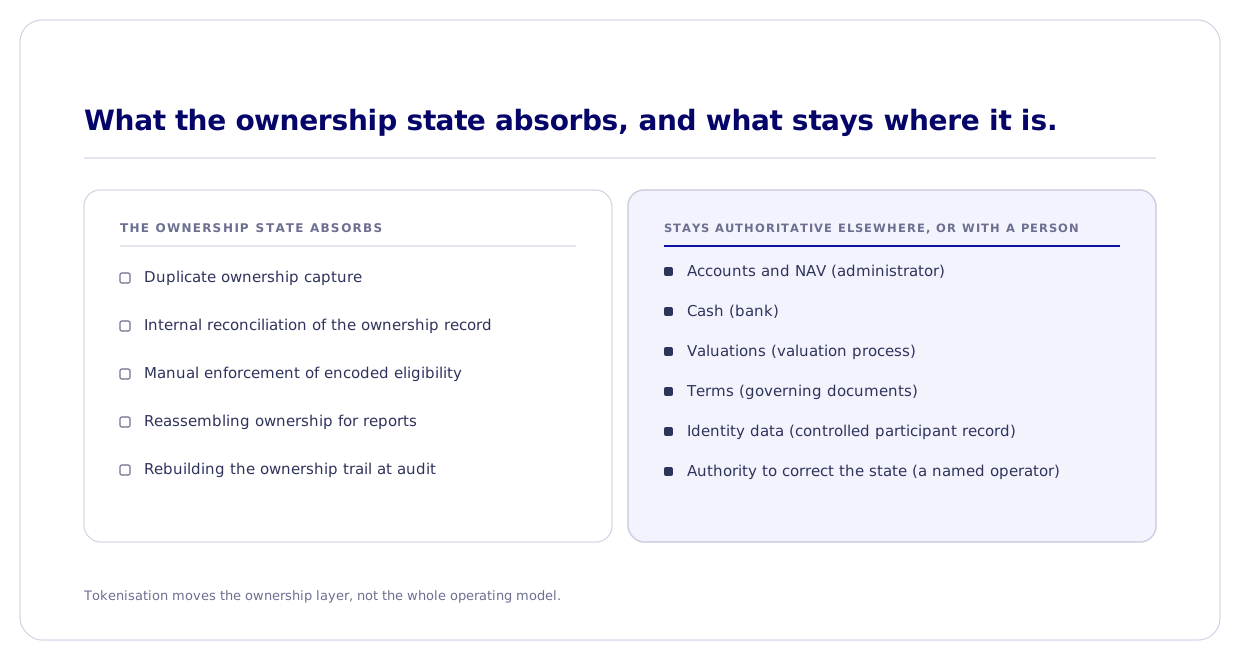
Be careful with the word "one" there, because a fund does not run on one record. It runs on several domains of authority. The administrator is authoritative for the accounts and the NAV, the bank for cash, the valuation process for valuations, the governing documents for the terms. Tokenisation does not collapse those into a single system, and it should not try to. What it can make authoritative is the layer underneath them: the ownership and entitlement state, meaning who holds which position, in what structure, with which rights, and the transactions that change it over time. Nearly every investor-facing event has to resolve against that state, which is why it is the piece to be pinning down first. It is also the piece a token moves.
One more thing to keep in mind - the token is not the operating model. A token can represent an ownership interest, carry transfer rules and update a ledger. It does not know which administrator is authoritative for NAV, which bank holds the cash, which document governs a side-letter entitlement, or which exception needs a person to approve it. Those are operating facts. Tokenisation earns its keep when the governed ownership state is connected to them, not when it pretends they are gone.
That is the load-bearing caveat. No two funds tokenise the same way, because no two funds start from the same operating model. Where your ownership state is already single and governed, many of the operational gains below are smaller, because you have done the hard part. Where the same ownership picture is spread across an administrator, a registry, a CRM and the spreadsheets that hold the seams together, more of the work below is real, and so is more of the benefit.
Scale is what sets the backdrop here, not necessarily a timeline. McKinsey puts tokenised market capitalisation at around US$2 trillion by 2030 in its base case, excluding stablecoins, across a range of roughly US$1 trillion to US$4 trillion. Read the direction, not the decimal. On its analysis the assets moving first are cash, bonds, money market and mutual funds, with private equity and alternatives a later wave. Your fund's place in that order is one more reason the change is not uniform.
Let's Start With What Doesn't Change
A token changes how the record of ownership is represented and how its rules are applied. It leaves the asset, the duties attached to it, and the judgement in running it exactly where they were. KYC and AML still apply. Someone still has to write the eligibility rule correctly before a system can enforce it. NAV, carried interest, the waterfall, FX, equalisation and tax reporting are still computed on the same methodology, by the same people or administrator, which stays authoritative for the accounts. A royalty interest recorded on a ledger is still a royalty interest, governed by the same agreement and enforceable in the same courts. Keep that fixed, because it is what keeps the rest of this honest.
.svg)
The Lifecycle, Stage by Stage
1. Structuring the fund and encoding the rulebook
Governance moves first, and it moves from a document someone enforces to a condition the record applies. Today, eligibility, lock-ups and transfer restrictions live in subscription documents and depend on people remembering to check them. Encoded against a tokenised ownership state, many of those rules can sit with the record, so a transfer that breaks one can fail when it is attempted rather than surface a quarter later.
Be precise about the limit. Encoding a rule enforces it but it does not write it. The approved list still has to be maintained, and a wrong rule encoded cleanly is still wrong, now applied the same way every time.
Authority stays with a person, and the clearest live example shows how. The Franklin OnChain U.S. Government Money Fund is the first U.S.-registered mutual fund to use a public blockchain within its official system of record. Read how it is built, though. Its transfer agent maintains the official record through a blockchain-integrated system: private shareholder data held in an internal book-entry system, transactional data recorded on-chain, the two linked, and the transfer agent in control of the integrated system and able to correct errors. So the shape is a governed record with the ledger inside it, and a named operator still accountable for the state. The substrate changed. The authority did not.
2. Onboarding and subscription
Onboarding is the most reconciliation-heavy stage in many operations, and it is where a shared state shows first. Today an investor's details are captured across AML, KYC, the capital account, the register, the administrator and the portal, and their status tends to live in whichever inbox last touched it. Captured once against a governed participant record, that information is entered once and read many times, with the eligibility state it produces made available to the ownership layer.
Keep sensitive identity data off the ledger, while making the resulting eligibility state available to it. The investor information itself sits in a controlled participant record, and it is the eligibility result, not the passport scan, that the ownership state consumes. That split is the job Tranche:gate does, which is also why the ownership registry is not asked to hold everything. What stays either way: the KYC and AML duties, the documents you collect, and the decision on who to admit. The saving is in the duplication, not the duty.
3. Capital calls and funding
A capital call is often the most painful recurring event in a fund. It means fixing each investor's unfunded commitment, calculating the amount called, applying fund terms and then investor-specific arrangements, issuing notices, taking payment and reconciling, usually across a call system, a banking system and a separate commitment ledger that all have to agree. Where commitment and funded-to-date data are structured against the authoritative ownership and entitlement state, the calculation can consume figures that are already current and governed, and the three-way reconciliation after most calls has less to do.
The judgement in how a call is structured stays where it was. What shrinks is the part where three systems are talked back into agreement about facts they should never have disagreed on.
4. The register: transfers and ownership events
A secondary transfer today means re-papering the position, updating the register, confirming eligibility and reconciling with the administrator so two records agree. Most of that is coordination across the seams between systems that each hold part of the same fact. Where eligibility is encoded, a permitted transfer between two eligible parties can clear its conditions and settle against the authoritative ownership state. The reconciliation that follows does not vanish. It narrows, from establishing who now holds the position to confirming the downstream records still line up with the state.
Keep this apart from liquidity, because the two get run together. Faster, cleaner transfer processing is available now. A liquid secondary market is a separate thing that waits on buyers who, for most private fund interests, are not there yet. And the legal work around a transfer, the documentation, tax analysis, sanctions and beneficial-ownership checks, does not vanish because the mechanical step got quicker.
5. Distributions and servicing
A distribution today means pulling the register as at a record date and cross-referencing a separate payment system, which works only when the two agree. Where entitlement state is governed alongside ownership, the workflow that runs the distribution can calculate and execute against that state rather than rebuild it first from several records.
Be exact about what that does and does not claim. Ownership does not produce the distribution: the realised proceeds, the waterfall, available cash and the terms produce it, on the same methodology as before. What the governed state does is resolve who is entitled to the result once it exists. It removes the gap between the register and the systems that pay against it, not the calculation.
6. Reporting, audit and evidence
This is the stage most often overstated, so state it narrowly. Who owned what, on which date, at what entitlement, is today reassembled from the register, the administrator and the CRM before a report can be produced. On an authoritative ownership and entitlement state, the reporting layer reads current holdings rather than reassembling them, and the calculations run on a state they no longer rebuild first.
Evidence moves the same way, with one careful line about how a ledger holds it. The ledger can carry a time-stamped, tamper-evident history of transactions, while the controlled registry governs the current state and any authorised corrections. History stays verifiable; the state stays governed. So who changed the register, which version was approved and who signed it stop being questions you reconstruct at audit season or when an LP's operational due diligence lands.
Hold the limit that the evidence itself carries. It shows what happened and in what order. It does not show the decision was right: a valuation committee can follow every step and still land on the wrong number. What it gives you is the ability to show the process was followed, and to have that hold when someone outside tests it.
Notice what just happened across all six. Governance, onboarding, calls, transfers, distributions, reporting: each one is the same move, an ownership fact reconciled across systems becoming a governed change to one authoritative state. The stages differ. The mechanism holds.
Where This Doesn't Go to Plan
Moving a record onto a ledger is not an improvement by default, and the sharpest illustration is close to home. The ASX spent years building a distributed-ledger replacement for CHESS, paused it in November 2022, and wrote down A$245 million to A$255 million of project costs before resetting to a conventional design. It went further than a write-down. In 2026 ASX admitted it had misled the market about the project's progress, and the Federal Court ordered a A$20.5 million penalty.
The penalty was for the disclosure, not a verdict on the technology. The independent review of the programme pointed to solution design, requirements, governance and delivery. Read the lesson precisely: a new ledger does not fix unclear requirements, fragmented authority, weak governance or a broken operating model. It inherits them. A token laid over an ownership state that several systems still argue about inherits the argument, now faster.
So the size of the change tracks your starting point. An ownership state that is already single and governed gains a change of substrate, real but modest, because the work was done. One spread across systems that reconcile into agreement gains more, and the project to get there is larger. Both are valid. The honest version only works once you have placed yourself on that line.
What Lands On Your Desk
The first tokenisation question a COO gets is unlikely, "should we launch a tokenised share class." It arrives as a request: an administrator, a settlement pilot or a large investor asks whether your register can serve as, or feed, a tokenised record. That is an operating decision, and your answer turns on how governed your ownership state already is, which is buildable now, before any token exists.
Three boundaries that you should be considering in light of this:
- The settlement rail is a choice, not a requirement. The ownership state can sit on a ledger while subscriptions settle in ordinary fiat through the rails you already use, or in digital money where an investor base wants it, set per structure. Anyone offering one rail as the only correct one is describing a preference.
- Settlement-window risk counts for less here than the headlines imply. Collapsing the gap between the asset leg and the cash leg is real, and it earns its keep on instruments that trade continuously. LP interests do not, so for most funds this is a minor line.
- Your administrator does not disappear. Its role shifts from maintaining and reconciling a parallel ownership record to operating against and reading from the governed state, while staying authoritative for the accounts and the NAV. The orchestration across that state, the approvals, exceptions and reporting that used to move by email, is where the week changes.
The Practical Takeaway
Put a token on a ledger and it changes little if the ownership state underneath it was never agreed. A token laid over a state that several systems still argue about inherits the argument. A token laid over a governed one inherits the governance. Same token, different result, and the difference is work you can start now, with no token in sight.
That governed state is what Tranche:source is built to hold: the authoritative state of ownership positions and the rights, entitlements and transactions attached to them, held as a record the systems you already run can read. Tranche:route carries it through the operation and runs the work that acts on it, the onboarding, the calls, the distributions and the reporting, across the administrator and accounting systems you keep. The administrator stays. The accounting platform stays. What changes is that one state becomes authoritative for the ownership everything else resolves against. That is what a tokenised record will ask of you when the request lands.