Most of what you have read about tokenisation was written for your investors and almost none of it was written for the people who run your operation.
That is backwards. Your operation meets tokenisation years before your investment committee does.
The Part Everyone Argues About, and The Part That Arrives First
You already know the category is real; AI, automation and tokenisation are being spent on, and you are past needing convincing they exist. You are also right to be sceptical of how the story usually gets told.
Because the story is an investment story. Fractional ownership. Secondary liquidity in positions that used to lock up for years. A wider pool of buyers for a fund that used to sell to fifty of them. Retail investors accessing complex, exotic, institutional grade opportunities.
All of that waits on a market forming: buyers, price discovery, distribution, demand. Markets form slowly.
There is a second story, and it reaches you first. Tokenisation changes how ownership gets recorded, transferred, reported and settled, and how the work around it is coordinated. Those are operations questions. They don’t land on an IC's mandate.
Here is the claim, stated plainly: a token changes your book of record before it changes your asset. Everything below follows from that.
One boundary first. How allocators will price a tokenised secondary, or how much demand there is for one, is not ours to assert, but the operational mechanics are.
A Token is a Record Before it is An Asset
Strip the crypto framing and tokenisation is narrow. The authoritative record of who owns what moves onto a shared ledger. The rules that govern that ownership get encoded next to it.
That is why operations feels it first. You do not need a market, a new investor or a change of mandate for a register to move onto a ledger. You need the record and the rules - which you (should) already have.
What changes is the form they are held in. And the form is yours to run.
Your Operation Runs on a Dozen Versions of the Truth
Here is the part most tokenisation pieces skip.
Your ownership picture does not live in one place. It is spread across an administrator, a CRM, an investor portal, a capital-call system, a compliance platform, a custodian, an accounting system, a document store, and the email and spreadsheets that hold the seams together. Each holds part of the truth, but none holds all of it.
So you reconcile. Constantly. Keeping those systems in agreement is the standing cost we have written about as operational debt: the recurring tax of making systems that should agree, prove they agree.
Slow transfers are one symptom of that. Assembled reports are another. Audit stress is another. The shared cause underneath is that no system holds the governed operational state. Each holds a copy, and copies drift.
This is what a token changes at the deepest level. It lets the ledger become the governed operational state that the other systems read from, in place of each keeping its own version to reconcile later. Governance, transfer, reporting, the lifecycle and settlement are the changes you notice. A single governed operational state underneath is what makes them move together.
What Changes in Your Operation, Before Anything Changes in Your Fund
Governance stops being a document someone enforces
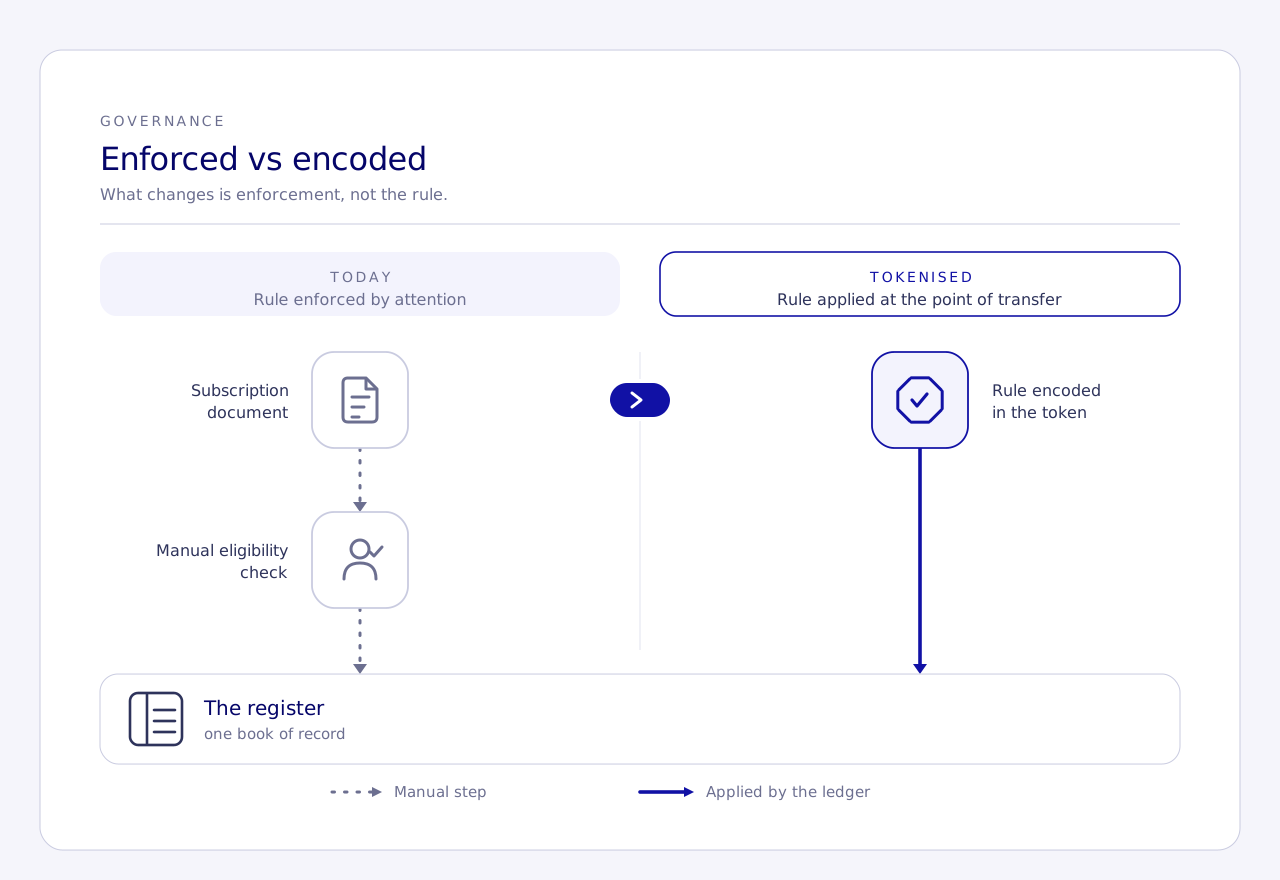
Today, eligibility, lock-ups and transfer restrictions live in subscription documents and get enforced by people checking. On a tokenised register, those rules can sit inside the token. The Project Guardian work led by the Monetary Authority of Singapore describes funds built on the ERC-3643 standard, where a token only moves between wallets that have cleared identity and eligibility checks. An ineligible transfer does not get caught next quarter…it fails at the point of transfer.
Be realistic about the limits though because encoding enforces a rule, but it doesn’t write one. The rule still has to be right, someone still maintains the approved list, and a wrong rule encoded cleanly is still wrong. What changes is enforcement: from a manual check that can be missed, to a condition the ledger applies the same way every time.
Transferability becomes an operation
Run a secondary transfer the way you do now. Re-paper the position. Update the register. Confirm eligibility. Reconcile with the administrator so the two records agree. Most of that work is coordination across the seams between systems that each hold a piece of the same fact.
Encode eligibility on the register and most of that coordination stops. The transfer clears the rules and completes, or it fails at the ledger. The record updates once, where other systems read from it, so there is nothing to reconcile afterwards.
Keep this apart from the promise it gets sold with. Cleaner, faster transfer processing is an operational change you can have now. A liquid secondary market is an investment outcome that waits on buyers who, for most private-market assets, are not there yet.
Ownership reporting becomes a read rather a reconstruction
Be careful with this one, because it is easy to overstate. Waterfalls, carry, fees, FX, equalisation, look-through and tax reporting still have to be computed. Tokenisation does not do your NAV.
What changes is the layer underneath them. Today, who owned what, on which date, at what entitlement, is reassembled from the register, the administrator and the CRM before any of those calculations can start. When the token carries that ownership and entitlement data, the ownership layer becomes a read against current holdings, and the calculations run on top of a record they no longer have to rebuild first.
The same holds for evidence. A tokenised record is immutable and time-stamped, so who changed the register, which version was approved and who signed it stop being questions you reconstruct at audit season. The trail is the record. For a manager fielding an LP's operational due diligence or a regulator's information request, that lineage can be worth as much as any settlement-speed gain.
The lifecycle stops being a relay race
Onboarding is the clearest case. A subscription runs through AML, KYC, eligibility, tax, the capital account, the register, the administrator, the portal, then reporting and audit. Each system owns one leg of that run. None owns the whole of it, so the hand-offs are manual and an investor's status lives in whichever inbox last touched it.
The happy path is the cheap part. Cost concentrates in the exceptions, and they are relentless: an investor changes legal entity, a tax residency moves, a wire is rejected, a side letter bites, a document expires, a sanctions screen hits. Each one today spawns emails, calls, approvals and another round of reconciliation.
Against a governed operational state, each step and each exception becomes a recorded change to one record, with the rule that applies and the approver attached. Governance extends across the lifecycle, not the token alone. The saving shows up only where it reaches these processes. Where it does, the coordination that used to move by email moves through the state itself.
Settlement collapses two legs into one moment
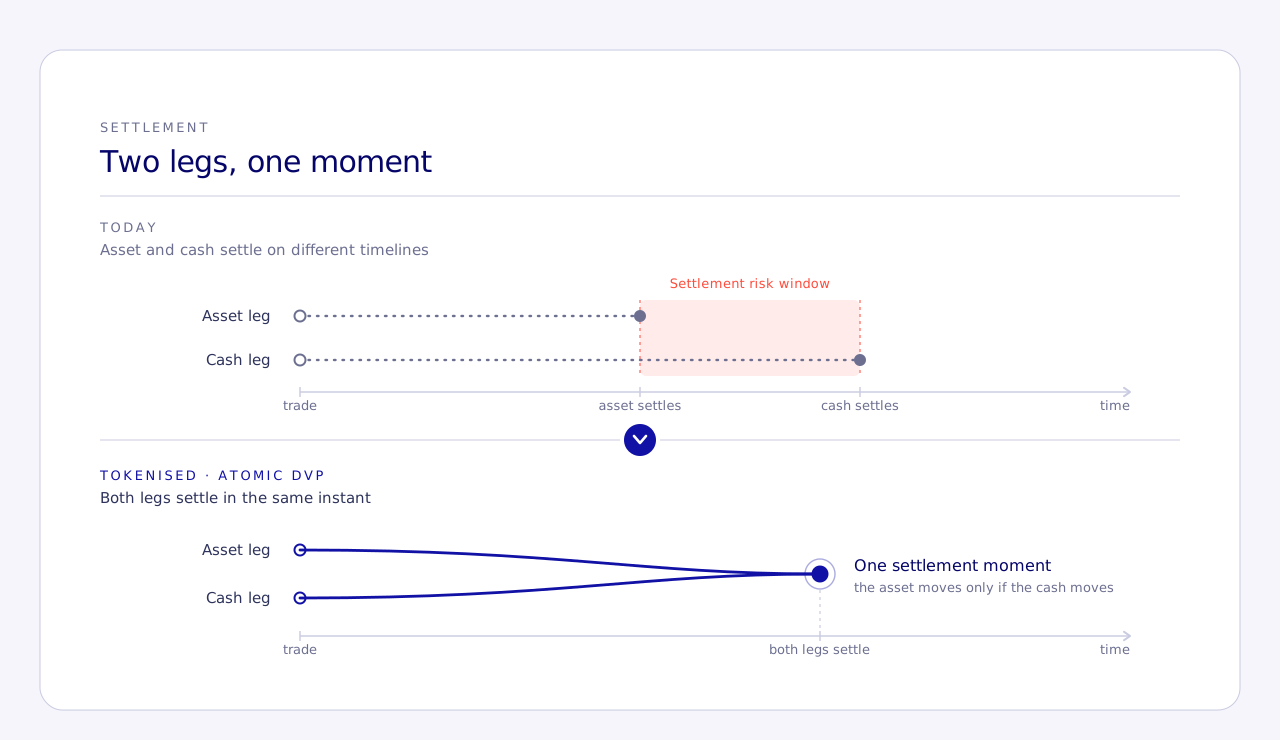
When you buy or sell, the asset leg and the cash leg move on different systems, on different timelines. The gap between them is settlement risk: the window where one side has moved and the other has not.
On a shared ledger, both legs can settle together. The asset does not move unless the cash does, in the same instant. That is delivery-versus-payment on tokenised rails, and it is the part of tokenisation that central banks chose to build first. In Australia, Project Acacia, run by the Reserve Bank and the DFCRC with regulatory relief from ASIC, tested live settlement of tokenised assets across fixed income, private markets and other classes, using more than one form of digital money.
That last point is where hype overreaches. There is no single correct cash leg. Acacia tested wholesale central bank digital currency, stablecoins and deposit tokens precisely because the settlement asset is a configurable choice, set by the counterparties, the jurisdiction and the risk each side will accept. Anyone selling you one rail as the answer is selling you their rail. The durable claim is narrower: settling both legs on one ledger removes a specific, expensive window of risk, whichever compliant cash leg you use.
Are you noticing the pattern? Governance, transfer, reporting, the lifecycle, settlement: every one of them is the same move. A fact you used to reconcile across systems becomes a governed change to one operational state. Digitisation is the surface of that. Governing a single operational state is the substance.
Why the Operation Feels It First
Line the two stories up and the timing stops being a guess.
The investment story needs other people to show up. Buyers, price discovery, distribution, demand. The operational story needs one thing: a governed operational state on a ledger, and your rules encoded. One waits on a market. The other waits on you.
The numbers fit that split. As of mid-2025, tokenised funds and vehicles held around $24 billion on RWA.xyz data, most of it private credit and Treasury products. Global money market funds hold roughly $10 trillion, on CFA Institute figures from October 2025. The tokenised investment market is still close to a rounding error.
Now look at the operational side over the same window. A central bank ran live settlement tests. A regulator group published a fund-tokenisation playbook. Encoded-eligibility standards went into production use.
Read that back. The part of tokenisation that touches how you record, transfer, report and settle is being built and documented now. The part that touches who invests, and how much, is still early. Your operation meets it first because your operation does not have to wait for a market.
What Lands on Your Desk
The first tokenisation question you get is unlikely to be "should we launch a tokenised share class to attract new investors."
It arrives as a request. An administrator, a settlement pilot or a large investor asks whether your register can serve as, or feed, a tokenised record. That is an operating decision, and how well you answer it turns on something you control today.
Here is the harder part. Tokenisation assumes a single governed operational state: one authoritative record of ownership, consistent data, and rules applied the same way every time. Most managers have never had that. They have coordinated systems that reconcile into agreement, and for years that has worked well enough. Tokenisation raises the bar to the governed operational state you never needed to build, which means the real question it puts to you is whether you run an operating model or a set of systems that mostly agree.
That is not an accusation. Coordinated systems got the industry this far. It is a prerequisite. A token laid over a fragmented record inherits the fragmentation, so the operational upside goes to whoever holds a governed operational state first, and that is buildable now, before a single token exists.
The Point of All This
Tokenisation will change investing. That change earns the attention it gets but do not put the cart before the horse.
It will change your operation first, and by a wider margin, because the record, the transfer, the report, the lifecycle and the settlement are all operational artefacts, and every one of them moves before the first new investor does.
The managers who benefit are the ones whose book of record is already single and already governed. A governed operational state is what tokenisation rewards. A dozen reconciled copies is what it strains.
That governed operational state is what Tranche:source is built to be: an immutable, API-first registry the rest of the operation reads from. Tranche:route is the orchestration layer that carries the lifecycle across it, so approvals, exceptions and reporting move through the governed state instead of the inbox. Neither waits on a tokenised market to be worth having, and both are what a tokenised market will ask you for.