You already produce data. The question is what state it is in when you produce it.
Every quarter your operation runs the same cycle. Capital calls go out, distributions land, positions get reconciled, and reports reach LPs, the auditor, and the board. The numbers exist, and most of them arrive on time.
Look at where they live. A capital call is a PDF notice. A valuation is a cell on a spreadsheet tab. An LP's position is a figure in a report that someone downstream re-keys into their own system. The facts are right. They are also locked inside documents, so every party who needs them opens the document and copies the numbers out by hand.
A data-native fund changes the order of operations. The record is structured and machine-readable the moment it is created, so the parties who need it read it directly instead of extracting it from a document. This piece is about that shift, from documents you produce to data you hold, and why it is starting to reach your operating model.
What 'Data Native' Means
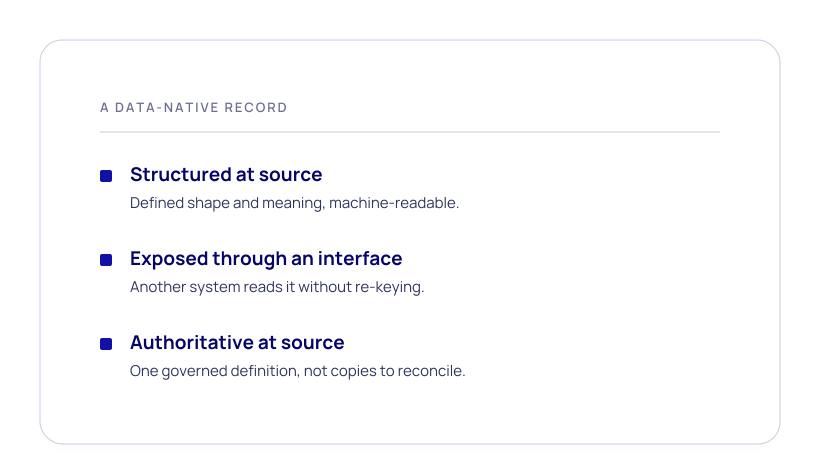
'Data native' describes where the data starts, not which software you run. A record is data-native when it holds three properties. It is structured at source, so it has a defined shape, and a defined meaning, that a machine can read. It is exposed through an interface, so another system can request it without a person copying it across. And it is authoritative at source, so every downstream system reads from the same governed definition rather than maintaining its own copy to reconcile by hand.
The contrast is one you already know. A PDF capital call notice carries the same facts as a structured capital-call record. The difference is that a person, or a brittle script, has to pull the facts out of the PDF before anything downstream can use them. Structured data removes that step, because the facts were never trapped in prose to begin with.
So the data-native question is not how good your documents are. It is whether the facts exist as data before they exist as a document.
Structured Data is the Foundation
Start with the system of record, because everything reads from it. In many operations the register lives as a set of spreadsheets, held together by the person who maintains them. That holds until it doesn't: a version conflict, a rekeyed figure, a control that runs inconsistently under time pressure, a key person on leave. This is operational friction you already track, and it has a name in your world, the "Excel tax."
The point is not that spreadsheets are poor tools. The point is subtler. A spreadsheet stores values, and it does not reliably store meaning: what a number is, what it relates to, and whether it is still current.
A structured record stores meaning alongside the value. Each figure knows what it is and what it belongs to. Change a valuation once and every downstream read sees the change, because there is one governed operational state rather than five copies drifting apart at the seams between systems. That same structure carries its own audit trail, which is the thing an auditor or an operational-due-diligence reviewer asks you to evidence, and the thing a spreadsheet is worst at.
Hold onto the meaning point, because it is the deeper one. Meaning is the part that has to travel between systems. Two systems can work together only once they agree what a figure like NAV, commitment, or distribution is. Storage is the easy half of that problem. Agreement on meaning is the hard half, and it is the half that makes everything later in this piece possible.
APIs Move the Data Without Re-Keying
An API is a defined way for one system to request or exchange data with another system without someone manually copying it across. Set aside the implementation.
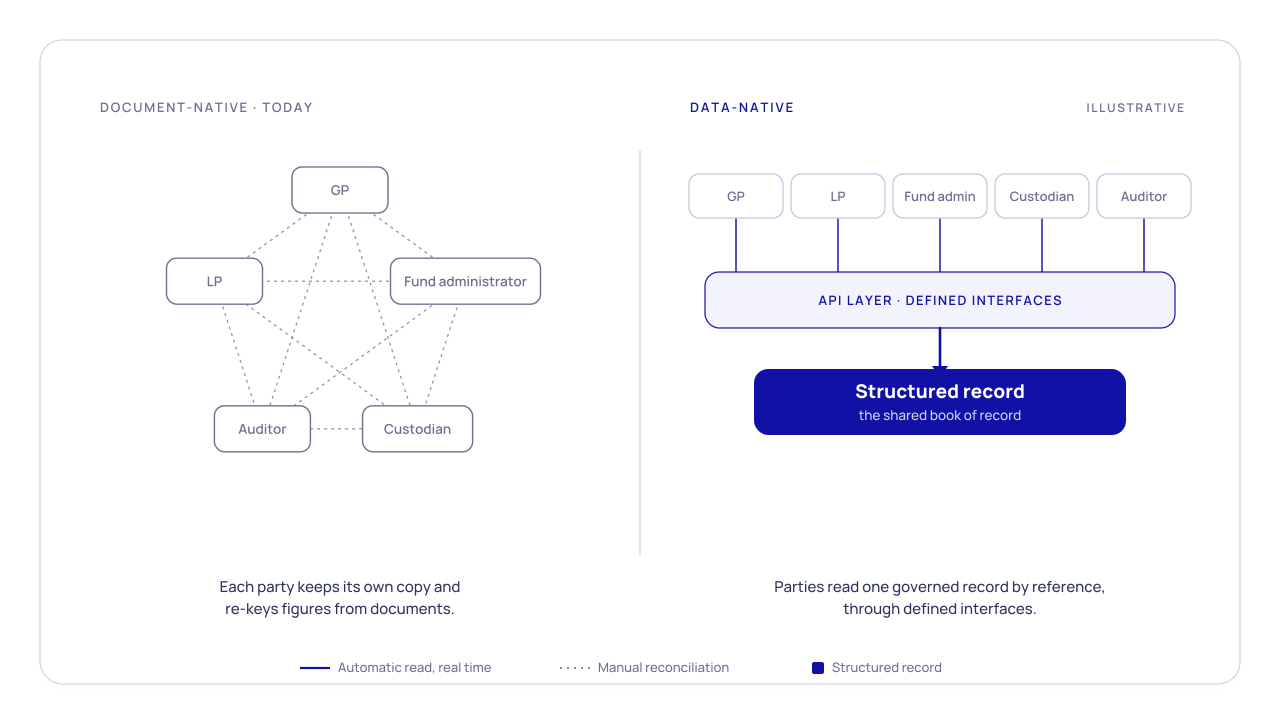
Hold the two versions side by side. Today your fund administrator sends a report, and your team reconciles it against your own numbers, by hand or through a fragile export. In the API version your system reads the administrator's figures directly, by reference, and stays in sync as they change, with no one re-keying a document. Reconciliation moves from a manual task toward an automated control. That work is one of the most persistent sources of operational cost you carry, recurring across capital calls, NAV, distributions, and reporting, so removing the manual version of it compounds.
But we can’t claim APIs to be the silver bullet - there are limitations. An API moves data between systems on request. It does not, on its own, collapse everyone onto a single shared copy. Copies still exist. The shift is that they reconcile continuously against an agreed definition rather than by hand. A single governed state is something that agreed definition enables, and the API is how the agreement travels. The value comes from consensus on what the data means and who may read it, not from any one connection.
Interoperability is the Payoff
A fund is, in simple terms, a small network. The GP, the LPs, the fund administrator, the custodian, the auditor, and the regulator all need a consistent view of the same facts. Interoperability rests less on the pipes between them than on agreement about meaning: they can exchange a figure by reference only once they agree what that figure is. Interoperability is a semantic problem before it is a technical one.
The industry is already doing that work. In January 2025 ILPA released updated reporting and performance templates for private equity, with adoption intended from the first quarter of 2026, and stated intent to adopt is running well ahead of the previous version, from LPs especially (ILPA). A standard template is the industry agreeing on the shape and meaning of what GPs report to LPs, which is the precondition for reading it by reference.
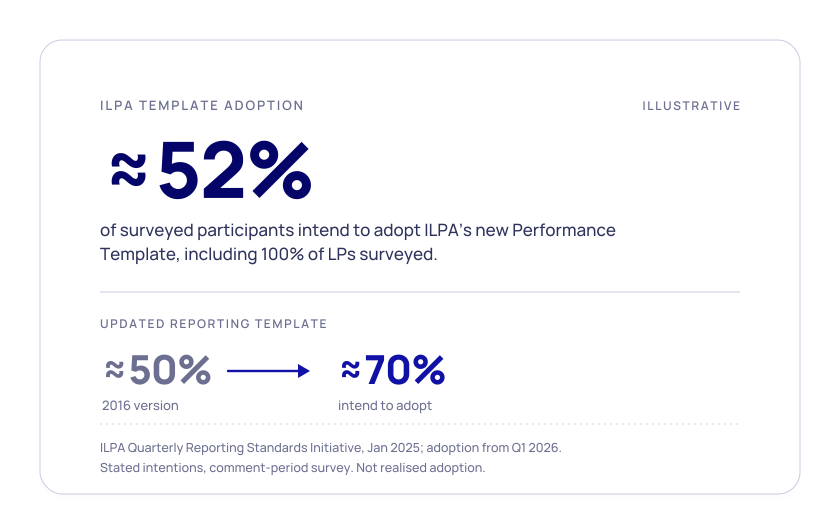
Notice the move. The template standardises the report. The data-native step is that the numbers behind the report are structured and carry their meaning at source, rather than being assembled into the template by hand each quarter.
Why This is Accelerating
A better architecture is not, on its own, a reason to move. Several forces are turning it from better into necessary, and they are arriving now rather than in five years.
Start with the nearest. Allocators increasingly want data they can pull cleanly into their own systems, and operational due diligence has hardened from a checklist into a gate. Reporting standards are formalising, as the ILPA templates show. Regulators are moving their own reporting toward structured, digital submission rather than documents. And the two technologies drawing the most attention both sit on this foundation: AI is only as useful as the structured inputs it can read, and tokenisation puts the register on a shared ledger, which changes little for you if the data feeding it is still trapped in spreadsheets.
Notice that these are not five separate projects. They are five pressures on the same point, the state of your data before it becomes a document.
What it Changes for the Operating Model
This is where it reaches the P&L. Private capital has matured into a core allocation, and McKinsey now describes private equity as a mature industry rather than an emerging one (Global Private Markets Report 2026). Maturity raises the bar on operations: LPs, auditors, and regulators expect timely numbers that reconcile.
When your record is structured and read through interfaces, the operation stops scaling one-to-one with headcount. Adding a fund, an LP, or a jurisdiction adds data to a governed structure, rather than another spreadsheet for someone to maintain and reconcile.
Two effects matter most to a COO. On cost and capacity, structured, connectable records give firms a better chance of adding AUM and fund count without operations becoming the constraint. On control, when every figure carries its meaning and its trail, you are far less likely to be caught by an auditor, an LP, or an ODD review asking you to evidence something you cannot reconstruct. Neither is a guarantee. Both are the defensible, repeatable version of the operational certainty you are trying to buy with headcount today.
Where This is Heading
Put the pieces together and the individual trends line up behind one shift. Private markets were built around documents. The next generation of fund infrastructure is being built around governed data. Tokenisation, AI, standardised reporting, and stricter operational due diligence are not separate stories. They are consequences of that shift, and each one rewards the firms whose data was already in a usable state.
None of this is a forecast. It is visible in the templates your LPs are already asking you to adopt. A fund built data-native from the register outward sits where that direction is pointing. That is the premise Tranche:os is built on: a governed operational state, held as structured data and read through defined interfaces, rather than a stack of reports reconciled after the fact.
You produce the data either way. Data-native settles its state before the document exists.