You do not need to read code to hold your own in a conversation about smart contracts. You need a clear picture of what one is, what it can carry, and how to tell a useful claim from an oversold one.
You Already Use These, You Just Call Them Something Else
Start from what you know before the new word arrives.
A GP who has ever set a stop-loss order has already used the core idea. You set a rule in advance: if the price hits this level, sell. From then on the system acts when the condition is met, without you approving it again each time. An escrow works the same way from the other side. The money releases when the stated conditions are satisfied, and not before.
A smart contract is that idea, applied to the terms of an agreement and placed next to the record it acts on. The Law Commission of England and Wales put it very simply in its 2021 advice to Government: computer code that, once a specified condition is met, runs by itself according to rules set in advance. Nothing in that definition requires crypto, a token, or a wallet. It requires a rule, a condition the system can check, and an action to take when the condition is true.
These arrangements are rarely smart in any ordinary sense, and the code is usually only part of the contract rather than the whole of it. The Law Commission was careful on this: the legal agreement remains the agreement, and existing contract law applies to it much as it does to a paper one. The code performs a step. The obligation, and its enforceability, stay where they were.
What It Looks Like Under the Hood
Every one of them reduces to the same simple shape.
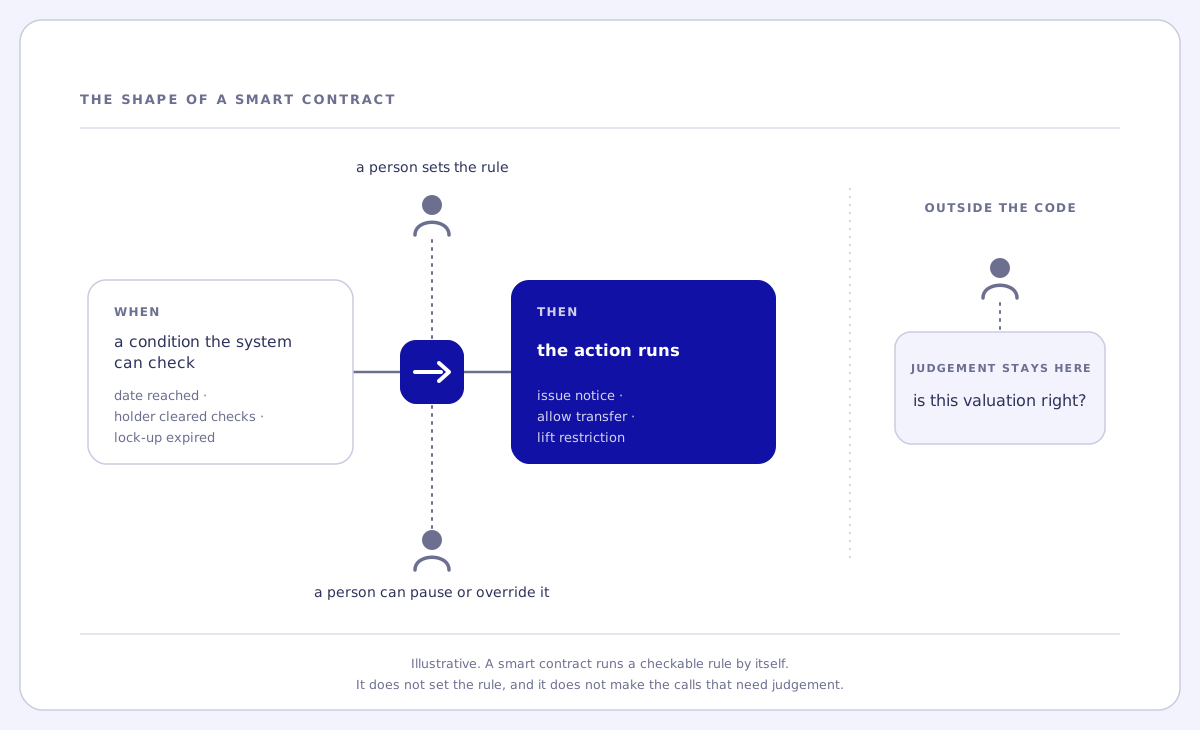
Strip the term back and the simplest smart contracts have the same shape: when a condition is true, an action runs. When the capital-call date arrives, issue the notice. When a holder has cleared the required checks, allow the transfer. When a lock-up has expired, lift the restriction. Each is a rule you almost certainly already have, written so a system applies it the same way every time rather than waiting for a person to act on it.
That is the whole mechanism a non-engineer needs to carry. The condition has to be something the system can determine from defined inputs. The action has to be something the system can carry out. Read that part again a couple of times because it is also the boundary of what smart contracts are capable of.
What A Smart Contract Can and Can't Carry
Good at the mechanical - silent on the matters of judgement.
The derivatives industry drew this line years ago, and it travels well beyond derivatives. In its Legal Guidelines for Smart Derivatives Contracts, ISDA separates the operational clauses of an agreement from the non-operational ones. Operational clauses carry conditional logic: on a defined event, a defined action follows. Those suit code. Non-operational clauses turn on discretion, interpretation, or a wider legal relationship, and those are difficult or pointless to automate.
Sort your own agreements against that line and the result comes quickly. A capital-call date, a lock-up expiry, an eligibility check, a step in a distribution waterfall: mechanical, and the same answer for anyone who runs them. A valuation, a decision to waive a breach this once, a discretionary consent: judgement, and no worse for staying with a person.
There is a commercial edge here that a board will recognise. The mechanical, repeatable checks are the ones that consume operations time and staff attention, cycle after cycle, so they are the parts most likely to reward automation. The parts that need judgement are not made better by pretending they are mechanical, and automating them tends to add risk rather than take out cost.
How To Tell A Useful Smart Contract Claim From An Oversold One
Four questions, no code required.
This is where accessibility is of real value. You will be pitched smart contracts, probably before long, and you can test almost any claim with four questions.
- Does this encode a rule we already have, or invent a new one? Encoding an existing, agreed rule is low-drama. A claim that the technology creates a new right, or a new kind of asset, is usually a different product wearing the vocabulary.
- Who wrote the rule, and who maintains what it checks? A rule is only as good as its inputs. If a transfer check reads an approved list, someone still owns that list. Code enforces a rule. It does not decide the rule is correct, and a wrong rule encoded cleanly is wrong every time it runs.
- Can we pause or override it? Automated obligations need a way to pause or override them when a dispute or an exception arrives, and that the discretion over how to respond needs to stay with the parties. Fast enforcement is useful. Enforcement the accountable person cannot stop is a liability.
- Does the claim assume a rail, or a market, that isn't here yet? Encoding a rule says nothing about how money settles, and nothing about whether a secondary market exists for your assets. A pitch that bundles those in is selling more than the mechanism. Those operating consequences are their own subject, and we have written about what tokenisation changes in an operation separately.
Answer those four and you have taken the measure of the claim without reading a line of code.
What To Take Away
A smart contract is a rule you likely already have, written so a system checks it the same way every time. It suits the mechanical, checkable parts of an agreement, and it leaves judgement with the people accountable for it. How much it is worth to you depends on your operation and on the rule itself, not on the word "smart."
For the parts it does suit, the value shows up only where the record it checks against is one you can rely on. That is an operating question before it is a technology one, and it is the right place to start. Tranche:source and Tranche:route are built for that groundwork, whether or not a single rule is ever encoded on top.