Panels become products. Regulators become participants.
For a few years, tokenisation in private markets lived almost entirely in conference panels and strategy memos, interesting in theory, not something anyone senior was actually signing off on. That's no longer true, and the shift isn't confined to asset managers deciding to launch a product. It's showing up inside the institutions that set the tone for everyone else, and inside the central banks that regulate them, which is a different and more interesting kind of signal than a fund launch on its own.
What The Launches Do Prove
Not a pilot in a lab. A product with a client's name on it.
In May, Hamilton Lane launched a tokenised share class of its Global Private Assets fund, built with Allfunds Blockchain and Apex Group as transfer agent, with BBVA Asset Management as first investor and initial distributor across Europe, the Middle East, Asia and Latin America. JPMorgan has tokenised a private equity fund for select private banking clients. KKR and Apollo have both launched tokenised vehicles of their own. None of this is quiet experimentation. These are live products, offered to real clients, by firms whose entire business depends on not embarrassing themselves in front of institutional capital.
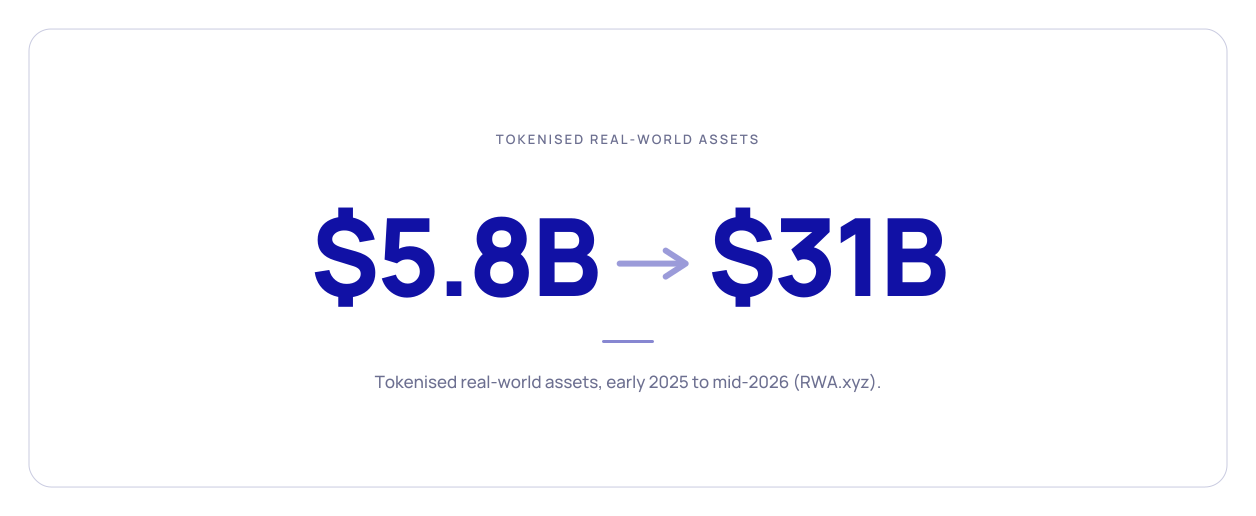
Zoom out and the picture shows things are early. Tokenised real-world assets overall grew roughly fivefold in that window, but most of it sits in things that were always going to be easiest to tokenise first, like Treasuries and money market funds. Tokenised private equity and venture vehicles combined still add up to a small fraction of a private markets sector measured in the trillions. Worth a caveat here: how a given tracker defines “private equity” versus “private credit” versus “structured product” varies enough between sources that the ratio is more useful as a direction than a precise multiple. Read it as small and growing quickly. Don't read it as a number to bet a forecast on.
What a Ledger Really Needs to Encode
A ledger that only tracks who owns what has tokenised only half the problem.
It's important to be precise about what a private fund interest actually is before talking about what a ledger does with it. It isn't just asset, owner, payment. A single structure can involve a master fund, several feeder funds, SPVs, multiple share classes in different currencies, side letters, preferential liquidity rights, investor-specific eligibility requirements, more than one class of carried interest, a waterfall with recycling provisions, a subscription facility, sometimes a NAV facility layered on top… the list goes on and on, along with reporting obligations that differ again depending on where the money and the manager each sit.
None of that complexity disappears because a register moves onto a ledger. But it would be a mistake to think of a tokenised ledger as a system that only records who owns what, the way a spreadsheet does. A properly built one encodes the actual terms attached to that ownership directly: who's eligible to hold an interest and under what conditions, what a transfer requires before the system processes it, how a distribution should be calculated and to whom, what's pledged against a position and to whom etc. etc. That's precisely why the mechanisms below work at all, they depend on conditions being encoded into the system, not just ownership being logged by it. The real work (and it is real work) is translating the specific terms sitting in a fund's legal documents into rules the system applies correctly and consistently every time. Getting that translation right is where implementations succeed or fail. It isn't a ceiling on what the technology can do. It's the actual craft of building one of these properly, and it's exactly the gap between a tokenised cap table and a tokenised operating record.
Seven Reasons, Not All Equally Important
Ranked by what actually matters in private markets, not by what's easiest to explain in one sentence.
1. Continuous position data, when the entitlement logic is built in
There's a distinction worth holding onto: who owns an interest, and what that interest is currently worth and entitled to, are two different questions, and a fair amount of early tokenisation activity only answered the first one, putting a register on a ledger and leaving NAV, fees, carry and waterfall calculations running separately in spreadsheets the way they always did. That's tokenising half the problem, and it's a fair criticism of a lot of what's been built so far. A properly designed system extends the same authoritative record to cover entitlement as well as ownership, so the current economic position and rights attached to a holding are calculated against the latest available data, rather than reconstructed periodically from several systems that quietly disagree in the gaps between updates. That's a different claim to continuously current valuation, which still depends on methodology, valuation date, underlying asset data and manager or third-party inputs the ledger doesn't generate itself. What the ledger removes is the lag and disagreement in applying whatever the latest valuation actually is, not the cadence of the valuation process feeding it. Ownership is still the base layer everything else is calculated against. The point worth making is that a well-built ledger doesn't have to stop there, and the ones worth paying attention to don't.
2. Servicing executed against one record that holds both ownership and entitlement
A distribution today typically requires someone to pull the register as of a record date and cross-reference it against a separate payment system, a process that only works if the two agree, and reconciling them is exactly where fund administrators lose their worst afternoons. Where the entitlement logic and everything else is built into the same system the ownership record sits on, rather than left running in a side spreadsheet, a distribution can execute correctly with nothing left to reconcile, because there was only ever one record governing both questions. Where a build stops at ownership and leaves entitlement elsewhere, you're back to the same gap as above, just showing up in a different process. This is the same distinction as reason one, applied to the moment money actually moves rather than to the record sitting still.
3. Capital calls, specifically, not just distributions
Capital calls deserve their own mention rather than slinking quietly inside “servicing,” because they're sometimes the most operationally painful recurring event in a fund's lifecycle. A call requires determining each investor's unfunded commitment, calculating the amount actually called, applying general fund terms and then investor-specific arrangements on top, issuing notices, receiving payment, reconciling… again, the list goes on and on. Today that whole sequence is typically spread across a capital call system, a banking system and a separate commitment ledger that all have to agree. Where commitment and funded-to-date data live on the same record the ownership sits on, a call calculation starts from data that's already correct rather than from a pull-and-reconcile exercise. That doesn't remove the legal and commercial judgement in how a call is structured. It removes the part where three systems have to be manually kept in agreement about facts they should never have disagreed on.
4. Programmable transfers, which is not the same thing as liquidity
This should be separated carefully, because the two get conflated constantly. For a transfer that's already legally permitted, between two parties who already satisfy the relevant conditions directly into the record means the system can check and clear those conditions itself, rather than counsel re-deriving each of them from scratch on every occasion. What it doesn't remove is the legal process itself. A transfer may still need formal documentation, tax analysis, regulatory checks, beneficial ownership analysis and sanctions screening, and none of that goes away because the mechanical part got faster. The important distinction: this improves transferability, the friction of moving an interest once two willing, eligible parties already exist. It does not, by itself, create a buyer. That's a liquidity question, and it's a different problem.
5. Verifiable encumbrances, when the record carries legal priority
Lenders financing a position, a subscription line, NAV-based lending, aren't currently working blind. They verify collateral today from a series of different sources, so the real problem isn't an absence of visibility, it's that verification is fragmented across several of those sources, slow, and dependent on multiple separate attestations rather than one record a lender can check directly. A ledger that records encumbrances against the ownership record itself fixes that, but on one condition: it has to actually carry legal priority. Encoding a pledge onto a ledger that the underlying legal documents don't recognise as authoritative doesn't create a better record, it creates a second one that now also needs reconciling. Building the legal wrapper and the ledger together, so the encoded record is the record the documents point to, is what makes this work, and it's a legal design question as much as a technical one.
6. Making smaller investors economically viable to serve
The honest version of this point is narrower than “fractional ownership” usually implies. It's true that the incremental cost of adding another holder to a tokenised register, processing their transfers, running their share of a distribution, is close to nothing. It is not true that the rest of the cost of serving a smaller investor disappears along with it. KYC, AML, onboarding, tax reporting, regulatory classification, suitability assessment, investor communications and ongoing support don't get cheaper because the register did. A hundred $50,000 investors still generate substantially more compliance and servicing work than one $5 million investor, full stop. What actually changes is that the register-and-servicing cost floor drops low enough that the remaining regulatory and commercial costs become the real question a manager has to solve deliberately, rather than the infrastructure cost making that decision for them by default before the question is even asked.
7. Settlement risk, probably the most overemphasised of the seven
Atomic settlement on a shared ledger is real and worth understanding correctly. Between the moment a transaction is agreed and the moment it settles, there's a window in which one side has committed and the other hasn't yet delivered, and collapsing that window to zero, both legs moving as a single transaction or neither moving at all, removes one specific category of counterparty exposure. It is not the only source of counterparty exposure. Default after execution, replacement cost risk, credit exposure, custody failure, liquidity risk, margin requirements, legal enforceability and settlement asset risk are all real and none of them are addressed by atomic settlement alone. The defensible claim is narrower than it's usually stated: atomic settlement can reduce a specific category of settlement and counterparty exposure, potentially reducing the associated liquidity and capital requirements, with the actual capital treatment depending heavily on the institution, the regulatory regime and the transaction type.
For where this article is focused, this is probably the weakest of the seven reasons to care, not because the mechanism isn't real, but because LP interests aren't traded continuously the way listed securities are. The settlement window atomic settlement collapses barely exists as a live, recurring problem for most private fund transactions today. It's the easiest of the seven to explain in a single sentence, which is likely why it dominates public conversation about this subject.
What separates a system that actually delivers on these seven from one that doesn't is whether conditions are genuinely encoded into the record itself, transfer rules the system enforces rather than a policy someone has to remember, entitlement logic the system calculates rather than a spreadsheet someone maintains alongside it, encumbrances visible on the record itself rather than tracked in a side letter. A ledger that stops at recording ownership and leaves everything else running in parallel systems hasn't actually delivered any of this. That's a meaningfully higher bar than putting a cap table on a database, and it's the bar worth judging any tokenisation platform against.
Australia Is Not Watching from the Sidelines
Twenty use cases. Real money, real assets, a central bank watching closely.
Project Acacia, a joint initiative between the RBA and the Digital Finance Cooperative Research Centre, ran from August 2025 to February 2026 with ASIC providing regulatory relief to let it use real money and real assets rather than simulations alone. Twenty use cases were tested across fixed income, managed funds, repos, structured products, private markets, carbon credits and trade payables, settled through a genuine mix of rails, stablecoins, tokenised bank deposits, pilot wholesale CBDC, and traditional RBA exchange settlement balances, deliberately run in parallel so no single settlement method was assumed to be the answer. The DFCRC estimates the broader shift to digital finance infrastructure could deliver around $24 billion a year in economic gains for Australia. The RBA published its final findings in May.
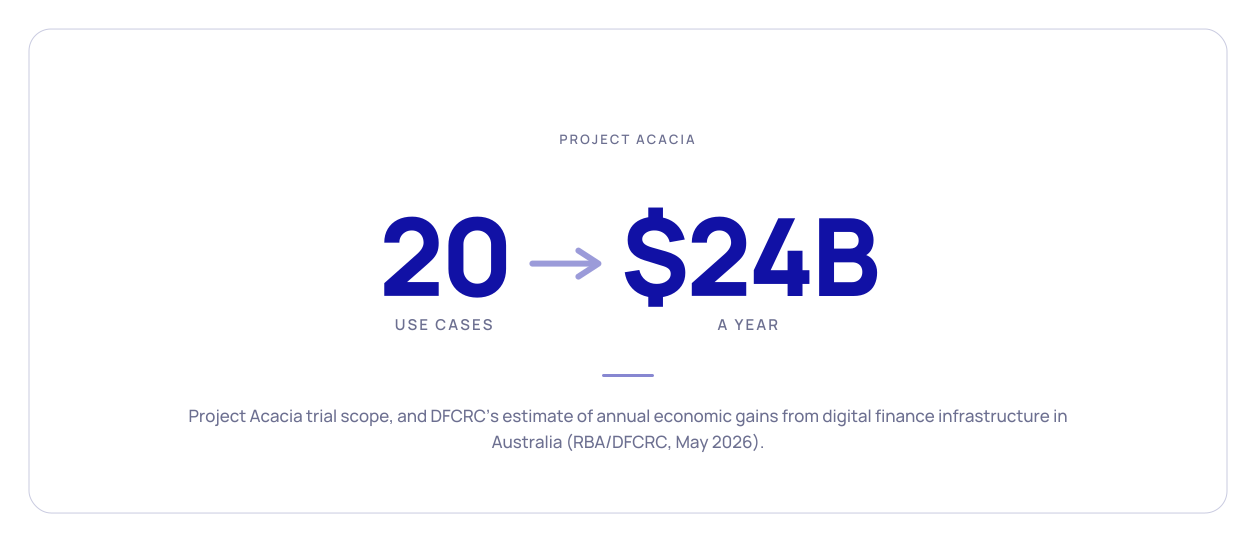
This isn't a private sector story that Australia is late to. It's a regulator-led trial, run with major banks and fintechs as participants, testing multiple forms of settlement side by side specifically so the findings wouldn't be captured by any one vendor's technology bet.
Singapore Didn't Wait Either
A framework this specific isn't hedging.
The Monetary Authority of Singapore's Project Guardian has run since 2022 and now involves more than 40 institutional participants. What's changed recently is the shift from proof of concept to genuine infrastructure. MAS's Global Layer One initiative is building shared standards for cross-border interoperability and what it calls compliance by design, regulatory checks embedded in the transaction itself rather than checked afterward. MAS has also published the Guardian Funds Framework, setting out best practice for how tokenised investment vehicles should actually be structured and governed. In a pilot under the same program, UBS Asset Management, Swift and Chainlink demonstrated settlement of tokenised fund subscriptions and redemptions bridged directly to ordinary fiat payment rails, proof that this doesn't require investors to touch a crypto wallet to participate.
What This Tells You
A pilot proves a question is worth asking. It doesn't prove the answer.
Institutions run pilots precisely because they don't yet know whether something will work, so a six-month regulatory trial with real assets proves the question was worth real time and real capital to investigate properly, not that the outcome is guaranteed to succeed commercially. What is important though is that neither the private sector nor the regulators overseeing it are treating this as a side project. Each is independently spending real resources, for their own reasons, shaping standards, understanding the risk, not wanting to be caught flat-footed if the infrastructure shift proves durable. That's a genuinely different signal than “everyone agrees this will work.” It's closer to: enough serious people think the question is worth answering properly that whatever the answer turns out to be, we want to know it sooner rather than later.
What Separates the Real Builds from the Announcements
Recording ownership was always the easy part.
The distinction that should be taken from this piece is the one running through all seven reasons above: whether a system merely records ownership, or actually encodes the rights, restrictions and entitlements that come with it. The first is a better spreadsheet. The second is a genuinely different way of running a fund's operations, transfer rules enforced automatically because eligibility is encoded rather than manually checked, distributions calculated correctly because entitlement logic sits on the same record as ownership, collateral visible because encumbrances are recorded where the position actually lives. That's a meaningfully higher bar to build to than most of what's been announced so far, and it's the bar that is very, very important. A tokenised register that stops at ownership hasn't done the interesting part yet.