The industry's favourite claim for tokenisation is that it opens private markets to everyone. This is a look at why that does not, by itself: the technology attacks the friction of transacting a fund interest, while access is held shut by friction of a different kind - which is actually a feature of the system.
Tokenisation arrives with a promise attached - access: fractional units in place of million-dollar minimums, secondary liquidity in positions that used to lock up for a decade, and a private market that finally opens to the people it has kept out. It is the industry's most repeated claim for the technology, and so it needs taking seriously enough to test.
The test is simple. Ask what keeps most investors out of private markets today, then ask how much of it a token actually changes. Tokenisation lowers the friction of transacting a fund interest. Access is held shut by friction(s) of a different kind, and most of it sits beyond the reach of a ledger. Tokenisation can be an enabler of wider access, but it is not, by itself, the mechanism that creates it.
The Promise Taken Seriously
Take the promise at its strongest. Private markets have been closed by size, with minimum commitments that start in the hundreds of thousands and climb from there. Break a fund unit into fractions, lower the minimum, and in principle more people can hold one - or a piece of one, or a piece of a piece of one. Add a venue where those fractions can trade, and a position that once locked up for years could change hands. Framed that way, tokenisation looks like a widening of who gets to own what, and the moral appeal of that is doing a lot of the work in how the story gets told. There is also a potential story on capital allocation efficiency and productivity, but that is for the economists.
The direction in general is not fantasy and this is not an argument that tokenisation does nothing. Lower the mechanical cost of issuing and holding a small unit and you remove one of the things that made small holdings uneconomic. The question is whether that one change is the binding one, and we feel, it is not.
Most Access Barriers Aren’t Technological
Ask why a given investor cannot buy into a strong private fund today and the answer is not really ever the cost of recording their unit. The barriers are structural, and a token is a transactional instrument.
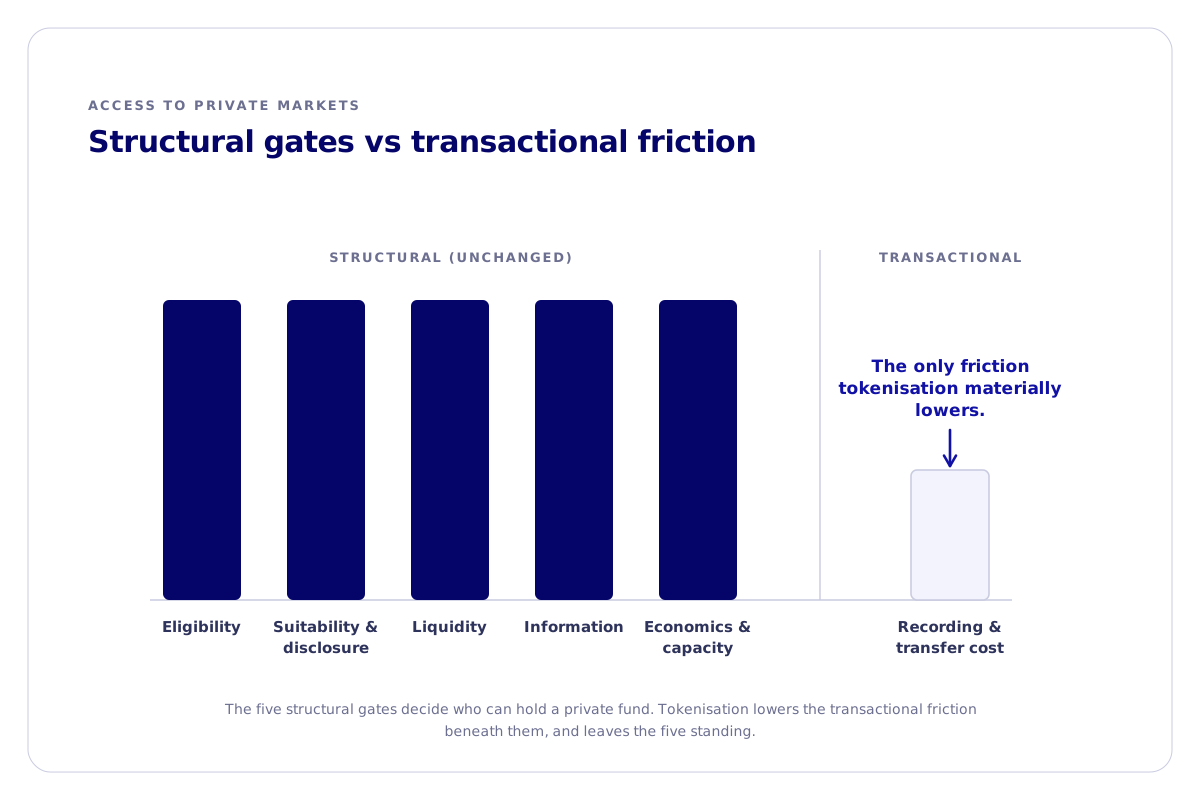
The Five Gates
Eligibility comes first:
Who may hold a private fund is set by regulation: wholesale, sophisticated, or accredited-investor rules that turn on wealth and income, not on the format of the register. A token does not change who is legally permitted to hold it.
Suitability and disclosure follow:
Private assets are illiquid, often blind-pool, and carry disclosure and suitability obligations that exist to protect the very investor the story wants to admit. Those obligations attach to the asset and its risk, not to the wrapper it trades in.
Liquidity is the one most often assumed away:
A secondary market needs buyers, sellers, and price discovery, and fractionalising an illiquid asset produces many small illiquid holdings until a market exists to trade them. A token can represent a position. It cannot manufacture demand for it.
Information is the barrier the access story most often skips:
Tokenising a fund interest makes the security easier to transact, and it does nothing to tell an investor whether the manager is any good, whether the valuation is credible, whether the strategy works, whether the fees are reasonable, whether the manager has capacity left, or whether the fund belongs in their portfolio at all. Private markets run on privileged information and hard-won judgement, and a ledger distributes neither. Making something easier to buy is not the same as making it easier to evaluate, and in private markets the evaluation is most of the work.
Economics and capacity is the barrier that survives even if the other four fall:
A strong fund has finite capacity, and the manager decides who fills it. Take a $2 billion fund. It can raise from twenty institutions writing $100 million, from a hundred writing $20 million, or, in principle, from several thousand smaller investors writing far less. The last of those is not the same fund with more holders. It is a different business, one that carries thousands of onboarding and KYC files, thousands of reporting and tax relationships, thousands of communications, and potentially thousands of transfer requests, and the economics of distribution and servicing change with them. Tokenisation can make each of those interactions cheaper to run. It does not make the underlying product suitable for that market, and it gives a manager who can fill the fund from twenty institutions no particular reason to take on ten thousand relationships instead. This is a distribution and servicing problem before it is an eligibility one, and lowering transfer cost does not resolve it.
What Tokenisation Actually Lowers
Set against those five, what tokenisation changes is narrow but definitely real. It lowers the cost of recording, holding, and moving a unit of ownership, which is the transactional friction of getting an interest onto a book and off it again. That is a genuine improvement, and it sits underneath the five gates rather than among them. The mistake is to assume that lowering it lowers the rest.
What That Doesn’t Create
The implication follows naturally from there. Lowering the cost of holding and transferring small interests does not create demand where there was none, does not summon a secondary market into being, does not widen who is eligible, and does not manufacture investment capacity in a fund that has none left to give. Those are the constraints that decide access, and tokenisation doesn’t inherently change those facets.
The Institutional Reality
Several years in, tokenisation remains an overwhelmingly institutional activity, which is what you would expect if the market structure has not changed. BeInCrypto's Real State of Tokenization in 2026 tracked roughly $60 billion in tokenised real-world assets across more than 7,000 products, and found that 97% of that value sits outside US retail reach, with about $1.7 billion, some 3% of the core market, accessible to US retail through 1940 Act structures (BeInCrypto Research). The rest sits behind institutional channels, offshore frameworks, and accredited-investor rules. Tokenised real estate, the asset class the democratisation story leans on hardest, sits at around $457 million and has shrunk this year. The value that has moved on-chain is concentrated among institutions, and the transfers themselves cluster around institutional-sized tickets rather than the continuous trading a retail market would show.
The standard institutions adopt reinforces the pattern. Serious tokenised funds run on permissioned tokens, which means a compliant token moves only between wallets that have already cleared identity and eligibility checks. The Project Guardian work led by the Monetary Authority of Singapore describes funds built on the ERC-3643 standard, where a transfer to an ineligible holder fails at the point of transfer rather than being caught and unwound a quarter later (MAS, Project Guardian). That is the feature institutions want, because it enforces the rules the same way every time, and it is also, plainly put, a gate. The more production-ready tokenisation becomes, the more its eligibility logic comes to resemble the rulebook the fund already lives under. The market structure has not opened, even though it has been re-encoded.
The Real Near-Term Opportunity
None of this makes tokenisation uninteresting to an institution. It makes the interesting part operational rather than distributional. Moving ownership and its rules onto a shared ledger can reduce the reconciliation between the systems that record a fund, a cost we have examined elsewhere and will not relitigate here. The point that belongs in this argument is narrower: the operational case is the part of tokenisation an institution can pursue without waiting for private markets to become liquid or retail-accessible. It does not depend on a secondary market forming, on a wider pool of buyers, or on a regulator redrawing eligibility, which is what makes it worth pursuing on its own terms. It is also not the same thing as democratisation, and it does the argument no favours to dress it up as one.
Conclusion
Tokenisation may still broaden access one day. If regulators expand who counts as an eligible investor, if compliant distribution channels and feeder structures lower minimums, if secondary markets develop and the cost of servicing and onboarding falls, and if products are designed for smaller investors rather than retrofitted to them, then tokenisation could be an important enabling technology in that shift. In that world it helps considerably. It still does not, on its own, cause the outcome.
So the honest position; tokenisation is an enabler of wider access, not the mechanism that creates it, and the access it is credited with depends on regulation and market structure that sit outside the technology itself. The sensible course for an institution is to judge tokenisation against the operational problem it actually solves, rather than the access story attached to it. It may eventually broaden who invests in private markets, but until the constraints that govern access change, treating that outcome as inherent in the technology is a mistake, and an expensive one to build a plan around.