For a long time, governance was the part of the conversation that happened before the real conversation. An allocator would ask for the policies, the org chart, the compliance manual, nod politely, and then get on to what they actually wanted to discuss, which was returns, pipeline, and track record. Governance was table stakes. It proved you weren't reckless. It didn't win you the mandate.
That's shifting, and it's worth understanding why, because it changes what governance is actually for.
Late last year, ASIC published a review of Australia's private markets that made a point most fund managers already suspected but rarely heard said so plainly by a regulator. It noted that wholesale managed investment schemes here carry meaningfully lighter oversight than comparable structures in Singapore, the UK, the US and Europe, and flagged that gap as something worth closing. Its own surveillance of private credit funds, conducted over the following months, found real and material inconsistency in how firms handled disclosure and fee transparency. Not a handful of outliers. Enough that the regulator felt the need to say so publicly.
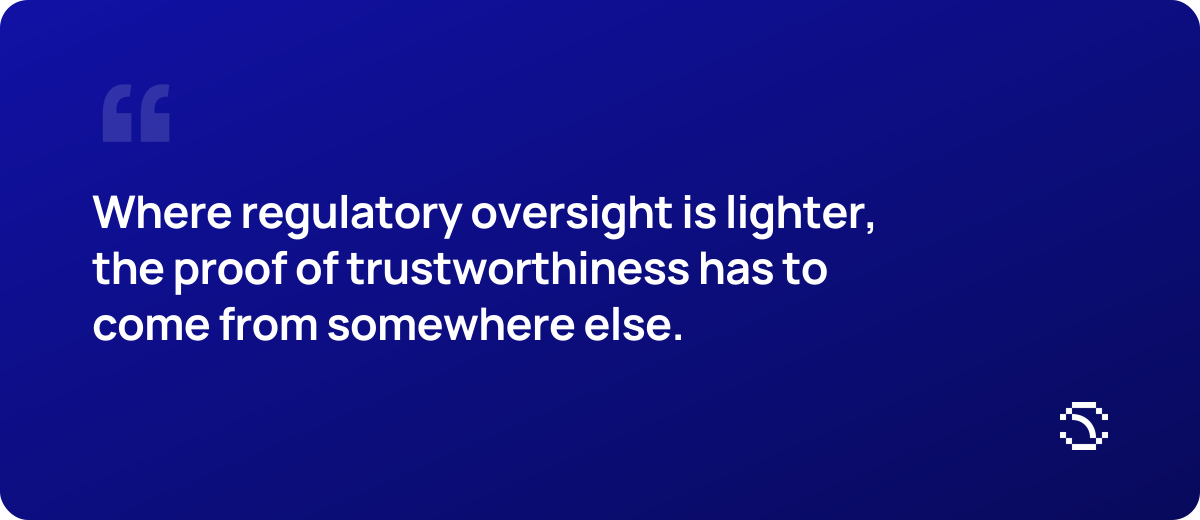
Here's the part that matters for how you think about your own business. When oversight is comparatively light, the burden of proving you can be trusted doesn't disappear. It just moves. It moves from the regulator's stamp to the manager's own operating evidence. If nobody external is checking your disclosure practices as a matter of routine, then your ability to show, clearly and on demand, exactly how you handle disclosure becomes the thing that actually earns confidence. That's not a compliance requirement. Nobody is forcing you to do it. It's a competitive one, because the managers who can produce that evidence easily will always look more credible than the ones who have to go build a special report every time someone asks.
This is the actual shift behind "governance is becoming alpha." Not that governance generates returns directly, it doesn't, but that in a market where a growing share of capital is arriving through lighter-touch structures, faster and with fewer external checks along the way, the managers who can demonstrate operational discipline convincingly and quickly are the ones who close faster, retain LPs longer, and survive scrutiny without scrambling.
The old model treated governance as a binder. A set of policies, written once, updated occasionally, produced on request and largely unread the rest of the time. It existed to satisfy a checklist, not to be used.
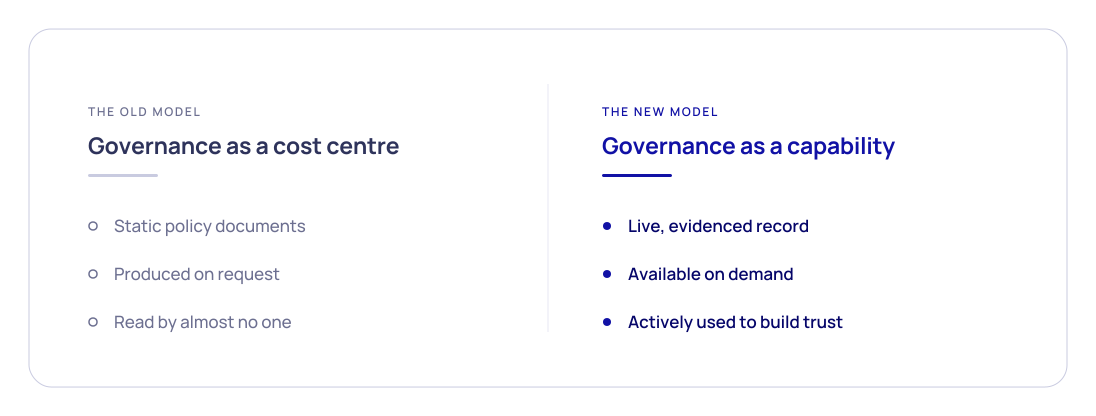
The newer model treats governance as something closer to infrastructure. A live record of how decisions actually get made, how conflicts get handled, how reporting gets produced and checked, available to be shown rather than reconstructed under pressure the week before an operational due diligence call. The difference isn't really about how many policies you have. It's about whether you can prove, in minutes rather than weeks, that the policies reflect what actually happens inside the business.
None of this is about doing more paperwork. If anything it's the opposite: the firms getting this right are the ones who've stopped treating governance as paperwork at all, and started treating it as a live output of how the business runs, something that gets generated automatically as a byproduct of good operations rather than assembled by hand under deadline. That's a much better place to be sitting when the questions start.