Institutional trust has a specific tell. It lives in the gap between a question and an answer.
When an allocator's operational due diligence team asks how you handle a conflict, price an asset, or produce an investor report, the speed and precision of the response says more than the policy document behind it. A firm that can show, on demand, how something works reads as trustworthy. A firm that needs two weeks to assemble the same answer raises questions about how consistently those controls operate, whatever its policies claim.
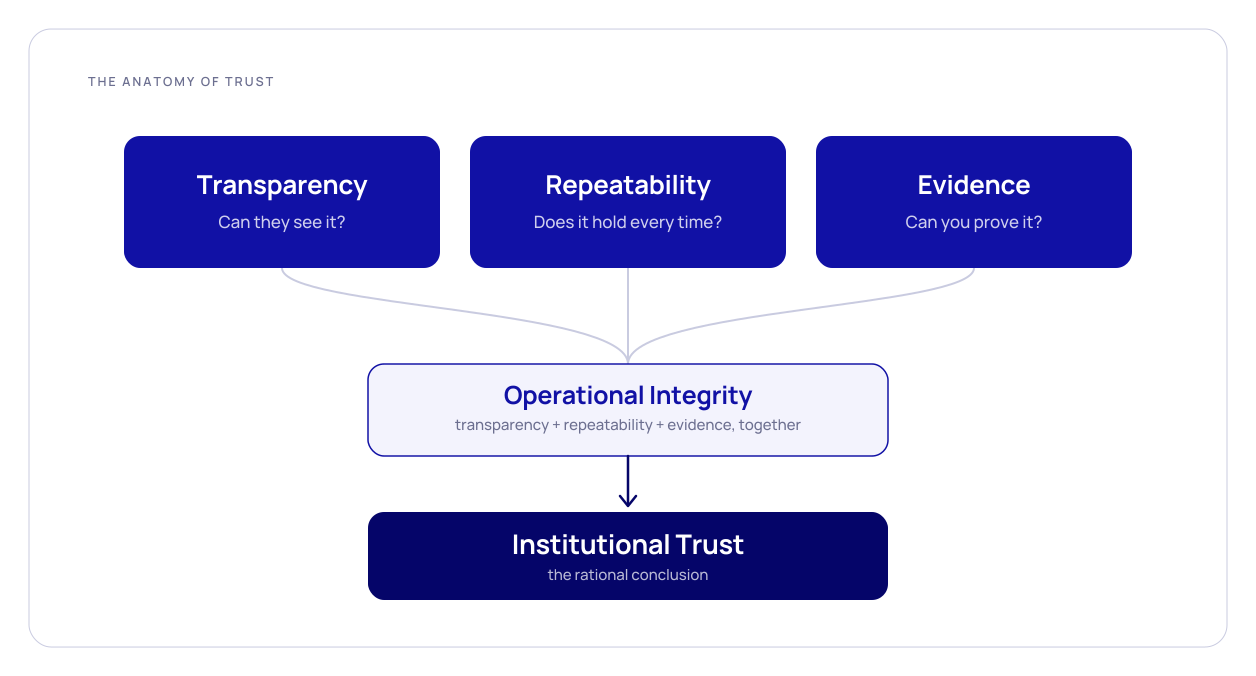
Trust of this kind is a conclusion an institution reaches after testing three things: whether it can see how your operation works, whether the operation runs the same way every time, and whether you can prove both. Transparency, repeatability, evidence. Together they amount to operational integrity, and institutional trust becomes a rational conclusion. Good governance creates the conditions for all three.
One caveat keeps the claim honest. Governance does not ensure every decision is the right one. It ensures every decision is made through a process that can be understood, challenged and improved. The bar it sets is consistency, accountability and traceability.
Regulators are Drawing the Same Line
ASIC's recent review of Australia's private markets flagged inconsistency in how firms handle disclosure and fee transparency, and noted that lighter-touch wholesale structures here carry less external oversight than comparable regimes in Singapore, the UK, the US and Europe. The through-line holds in every jurisdiction: as routine external checking thins out, the burden of demonstrating sound governance moves onto the manager's own operating evidence. When nobody outside is verifying your practices as a matter of course, your capacity to demonstrate them becomes the thing that earns confidence.
For a general counsel or head of compliance, that reframes the job. Governance stops being a defensive archive and becomes the mechanism that allows institutional confidence to be demonstrated on demand. Institutions allocate capital under uncertainty. Good governance reduces one of those uncertainties by making a manager's behaviour visible, consistent and provable before it is ever tested under pressure.
Transparency: Can They See How it Works?
Transparency gets read as volume, so the report grows longer. The institutional version is narrower and more demanding. It asks whether an outsider can see how a decision was reached, not just what was decided. How was that asset valued, and by whom? Which check sat between the instruction and the transfer? Who approved the exception, and against what rule?
A firm operating with real transparency can answer those questions in the moment, because the answers are an inherent characteristic of the operating model rather than a report someone builds later. That visibility is what lets an allocator move from asking about your controls to trusting them.
Repeatability: Does it Hold Every Time?
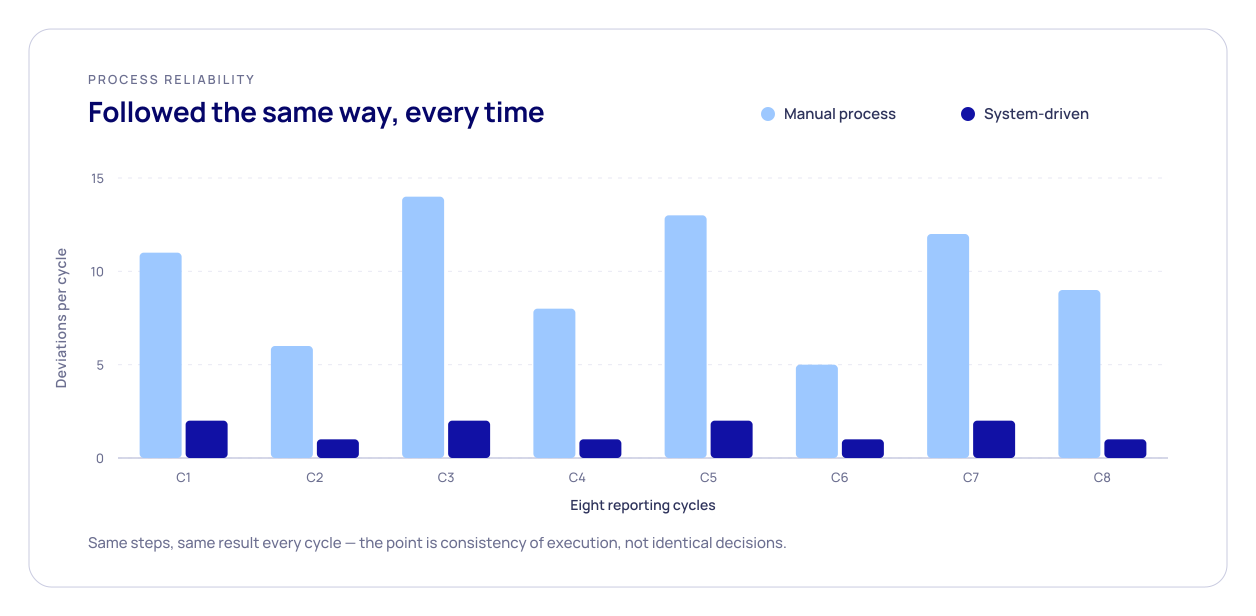
A process earns trust when it is followed the same way every time, regardless of who performs it, how compressed the quarter is, or how many entities sit inside the structure. What stays fixed is the path to a decision, while the decision itself moves with the facts: an investment or valuation committee should reach different conclusions when circumstances differ. Repeatability is the property that survives growth and staff turnover. It removes the quiet dependency on one person remembering the right sequence, and it closes the version drift that creeps in when the same task is performed by hand a thousand times instead of a hundred.
This is where fragility hides. A control that works when a senior operator runs it and slips when they are on leave is not one an institution can rely on. Consistency across cycles, entities and people signals a firm that scales without breaking.
Evidence: Can You Prove It?
Evidence is the record that lets someone confirm what happened without taking your word for it. Every ownership change, approval, valuation and distribution leaves a trail, and the quality of that trail determines how a firm looks under scrutiny. A complete, timestamped, attributable and tamper-resistant record turns an audit or an ODD call into a retrieval task. A partial one turns it into an investigation.
Picture the moment it matters. An allocator asks how an exception to a valuation policy was handled six months ago. One manager produces the approval chain, the timestamps and the supporting documents inside the meeting. The other offers to follow up once they have spoken to finance, operations and the administrator. Both may reach the same answer in the end, though the confidence created in the room is not the same.
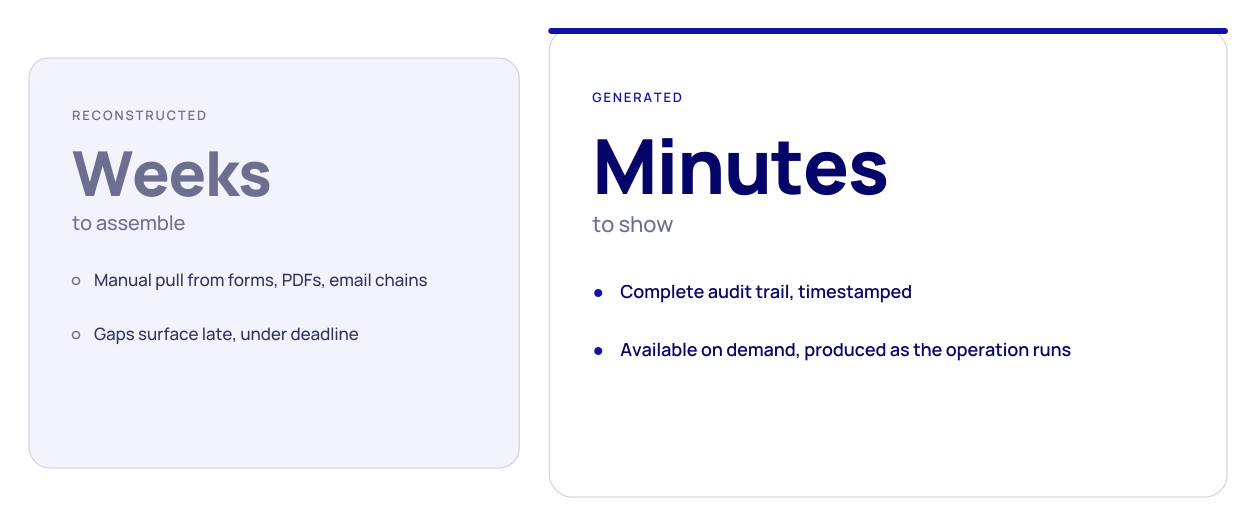
The gap between a firm that reconstructs its evidence and one that generates it shows up under pressure. Reconstruction means pulling application forms, PDFs and email chains together the week before a deadline. Generation means the record already exists, produced as the operation runs. The first firm hopes it can prove its position while the second knows it can.
Where Technology Fits
Technology matters here only insofar as it helps produce those three properties. When onboarding, ownership records, workflows and reporting run through connected systems rather than a chain of spreadsheets and inboxes, the three properties above stop being things a firm prepares for and become things the operation produces on its own. Transparency becomes a live view instead of a compiled report. Repeatability becomes the default, because the system runs the sequence the same way each time. Evidence accumulates as a byproduct of normal activity, rather than a project assembled under deadline.
The value shows up as a governance record that reflects what the business does, generated as the work happens, ready to be shown.
The Shift for Compliance and Legal
For the people who carry governance inside a firm, this is a better place to stand. The work moves from defending trust under deadline to maintaining a system that produces it as a matter of routine. Policies stop being a binder that gets updated once a year and set aside. They become a live output of how the business runs, visible to anyone who asks, consistent across every cycle, and backed by a record that holds up on its own.
The firms that get this right can show, in minutes, that the manual and the machine say the same thing. That, more than the length of any compliance manual, is what earns institutional trust.