There are two conversations about AI in fund management right now.
The first one is scared.
Will the model come for the analyst, the associate, the person who builds the deal?
The second one is relaxed.
AI will clear the grunt work, and everyone gets their afternoons back.
Both are wrong. And both are wrong for the same reason: neither has looked at what the technology needs before it can do anything useful inside a fund.
So let's start with the prize.
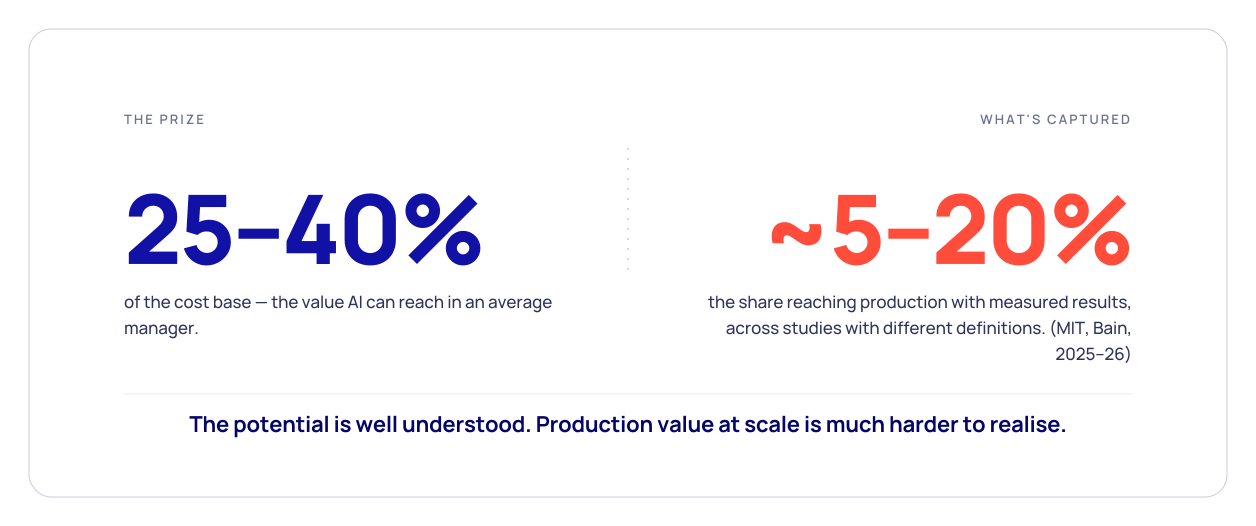
McKinsey's analysis of the asset management industry, evaluating firms representing roughly 70% of global AUM, valued the combined impact of AI, generative AI and agentic AI at 25 to 40 percent of an average manager's cost base. As their researchers noted heading into 2026, capturing that value requires decisive re-platforming and redesigning end-to-end workflows, not bolting automation onto isolated tasks.
A quarter to two fifths of your cost base. That is the number every GP deck is now built around.
And the industry has responded with cash. By 2026, most private equity firms had put more than a million dollars each into generative AI, and roughly nine in ten middle-market firms had adopted it in some form.
So spending is not the constraint and conviction is not the constraint.
The constraint is capture.
A Prize Almost Nobody is Collecting
Here is the part that does not make the AI slide.
The failure data is now consistent across independent researchers, and it is brutal.
RAND's work on why AI projects fail put the failure rate above 80 percent (although it's a little over two years old - the insights are still very telling). That is close to twice the rate of conventional IT projects, and RAND traced the cause to data and organisational problems rather than the models themselves.
MIT's Project NANDA established the benchmark in late 2025 and the industry is still struggling to beat it. Across more than 300 public initiatives, their research found that 95 percent of enterprise generative AI initiatives showed zero measurable return on the P&L under the study's own criteria. Read that carefully: it is a specific finding about measured P&L impact, not a blanket claim that 95 percent of AI work is worthless. The distinction matters, and I will come back to it.
Private equity is no exception. Bain's ongoing tracking of portfolio companies found in 2025 that only about a fifth had moved a generative AI use case into production with real results, leading their Global Private Equity Report 2026 to conclude that winning firms will need to 'build systems, not slogans'.
And the pattern shows up from the inside too. Across RSM's Middle Market AI tracking through 2025 and 2026, adoption consistently hovers around nine in ten firms. Yet the share that have successfully embedded these tools fully into core operations remains a stubborn minority, originally benchmarking at just one in four.
So the money is spent and the tools are in the building, but the return is arriving for only a small minority.
Which raises the obvious question: what separates that minority from everyone else?
It is not the model. Most firms are choosing from a relatively small set of capable foundation models, and the model is rarely the differentiator.
The difference sits somewhere else.
You Cannot Reliably Automate an Undefined Operation
This is where both comfortable conversations fall apart.
Gartner's projections for 2026 pointed straight at the cause. In a survey of data-management leaders, 63 percent said they either lacked or were unsure they had the data practices AI requires. Consequently, Gartner maintains its prediction that organisations will abandon 60 percent of AI projects unsupported by AI-ready data through the end of the year - let's see if that prediction holds true.
The pattern under every headline failure rate is the same. The technology works. The ground it was placed on did not hold.
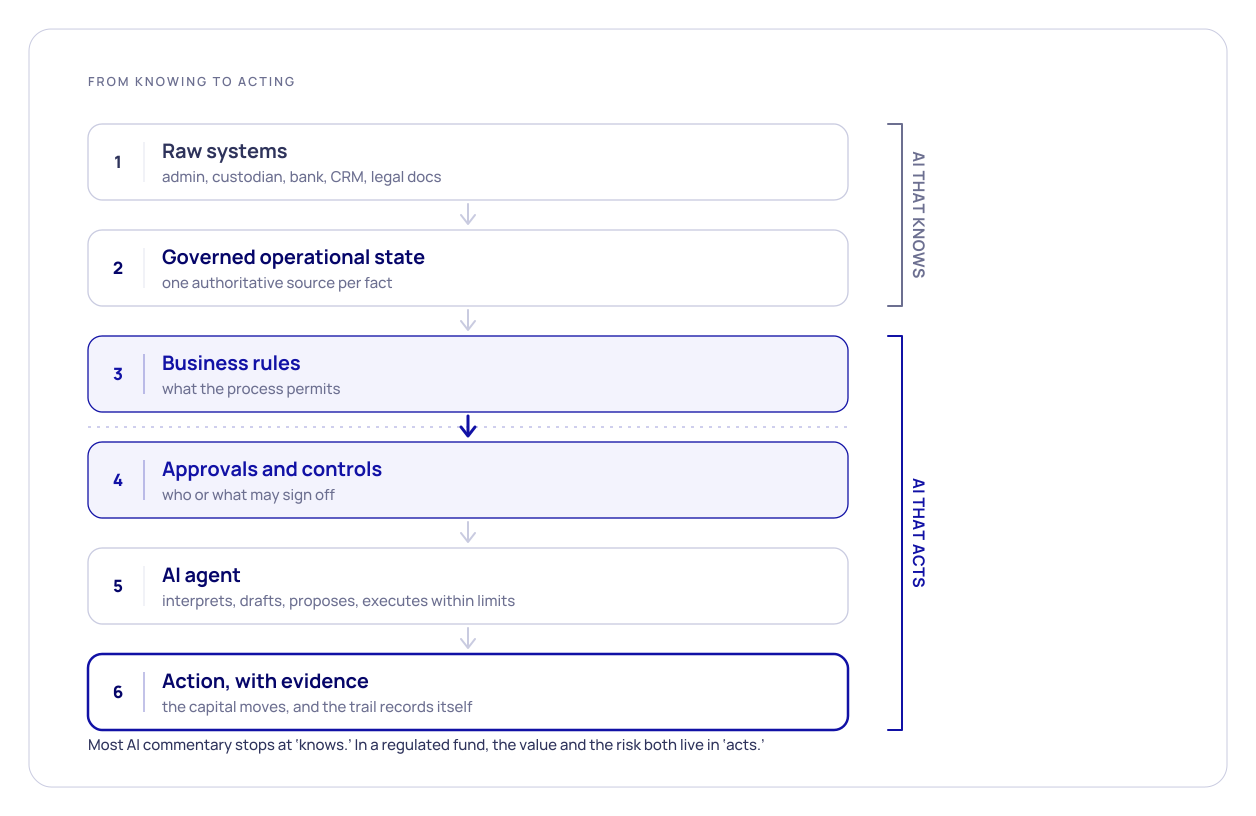
For a fund, that ground is what a computer scientist would call state: the current, authoritative picture of who holds what, in which structure, entitled to what, moved when, approved by whom.
In most operations that state does not exist as one governed thing. It is spread across a fund administrator, an internal book kept in parallel, a CRM, a compliance folder, and a set of spreadsheets that agree with each other most of the time.
The daily reconciliation exists for one reason: those sources disagree, and someone has to decide which one is right before anything can happen.
Now point an AI agent at that. Two things can happen.
Used with care, it reads across the sources, flags the conflicts, and routes the exceptions to a person. That is a real and useful job.
Used without controls, it reads three versions of the truth, picks one with total confidence, and acts at machine speed. When that answer is wrong, it is wrong faster than any human would have been, with a distribution or a capital call already sitting on top of it.
That second mode is the risk. And it is why "just add AI" quietly terrifies anyone who runs operations.
But fragmentation is only half the problem.
The other half is definition.
A capital call can run on perfectly clean data and still resist automation, because the process itself carries discretion. Side letters. Investor-specific treatment. Exceptions. Points of legal interpretation that no model should settle alone.
Automating a process nobody has defined does not remove the ambiguity. It executes the ambiguity faster.
So here is the honest version of the claim, and it is harder to argue with than the hype: you cannot reliably automate an operation that is undefined, fragmented, or both, without raising the risk of error faster than you raise throughput.
That is the step both conversations skip. And it is the reason the capture rate sits where it does.
The Data Sets the Ceiling. Structure Sets it Higher Than "Clean"
There is a tempting way to say this that happens to be wrong. So let's get it right.
Data quality is not directly proportional to AI performance. Doubling the quality of your records does not double the output. The relationship has a shape, and the shape is the whole point.
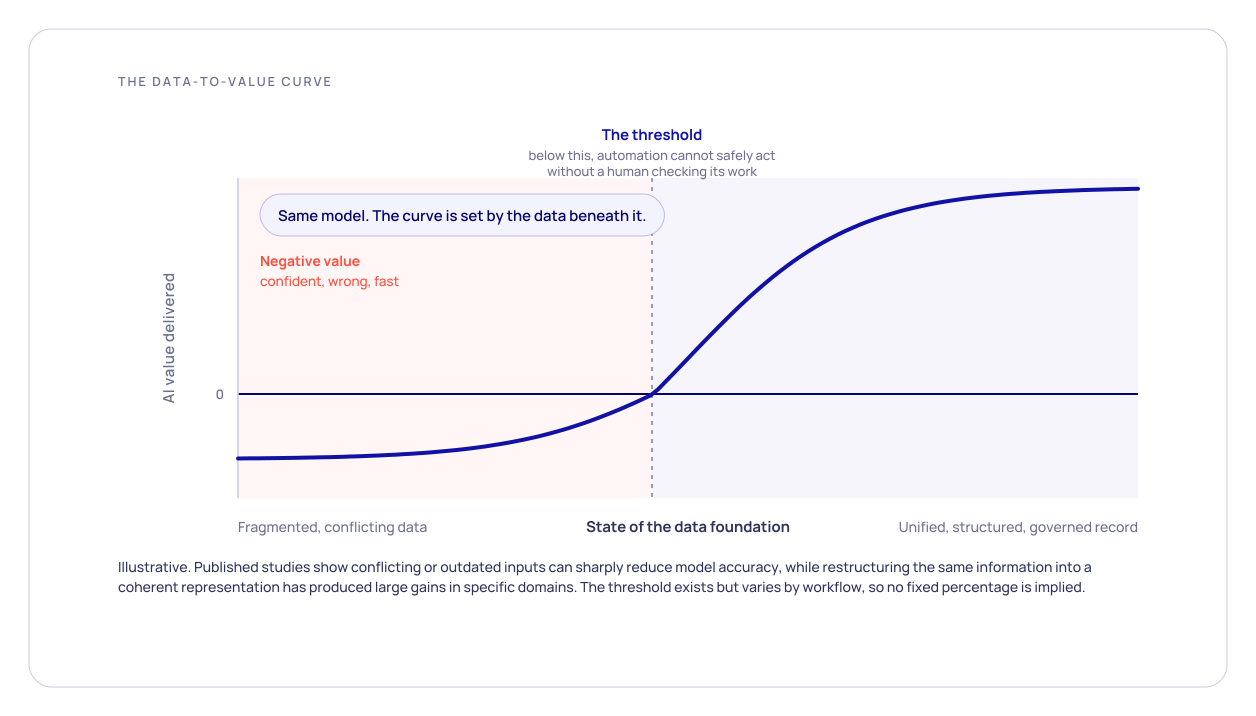
Start at the bottom. Below a certain threshold, worse data does not buy you a smaller benefit. It buys a negative one.
Researchers testing language models on outdated and conflicting inputs measured accuracy dropping by at least 20 percent, and in some cases below the level of random guessing.
The same study found something sharper. When information is missing, a model may flag uncertainty or make a reasonable inference. When the information it retrieves is wrong, it often produces confident answers built on that incorrect input.
Sit with that for a second. Bad data does not slow the model down. It can turn a hedge into a fast, confident mistake.
That is the floor. Below it, letting an agent act on its own creates more operational risk than operational value.
Above the floor, the shape is not a smooth ramp either. In a regulated workflow, value stays low until the data crosses a threshold of reliability and control, then rises sharply once an agent can be trusted to act inside it.
Structure is what carries data across that threshold. In one clinical workflow, researchers raised a model's accuracy from 43 percent to 99 percent without adding data or changing the model, just by restructuring the same information into a single coherent source. It is a narrow benchmark, used here to illustrate the effect rather than to promise the same numbers in a fund.
The lift came from structure. Not volume.
And in a fund, the threshold is unforgiving. A single wrong beneficial-ownership record can turn a compliant process into a regulatory problem. "Close enough" is not a place automation can safely stand.
Which brings us to the distinction the word "clean" hides.
Clean data is accurate and current. Structured data is machine-readable and consistently modelled. Unified data is one source in place of five.
Three different properties. And for AI, the third one does the heaviest lifting.
Models can often detect a conflict between sources. What they remain poor at, without explicit governance, is judging which conflicting source should be treated as authoritative. So a single well-structured record with a few rough edges is safer ground than five pristine records that disagree with each other.
Read that again, because it inverts the usual advice. In a fund, the thing that breaks AI is rarely dirty data on its own. It is disagreeing data. And that is a problem of structure and unification, not hygiene.
Two firms can license the identical model and get opposite results. The difference is settled below the model, in the state of the data underneath it.
You cannot out-model a fragmented foundation.
What "AI-ready" Means for a Fund
Gartner has the most specific definition going, so start there.
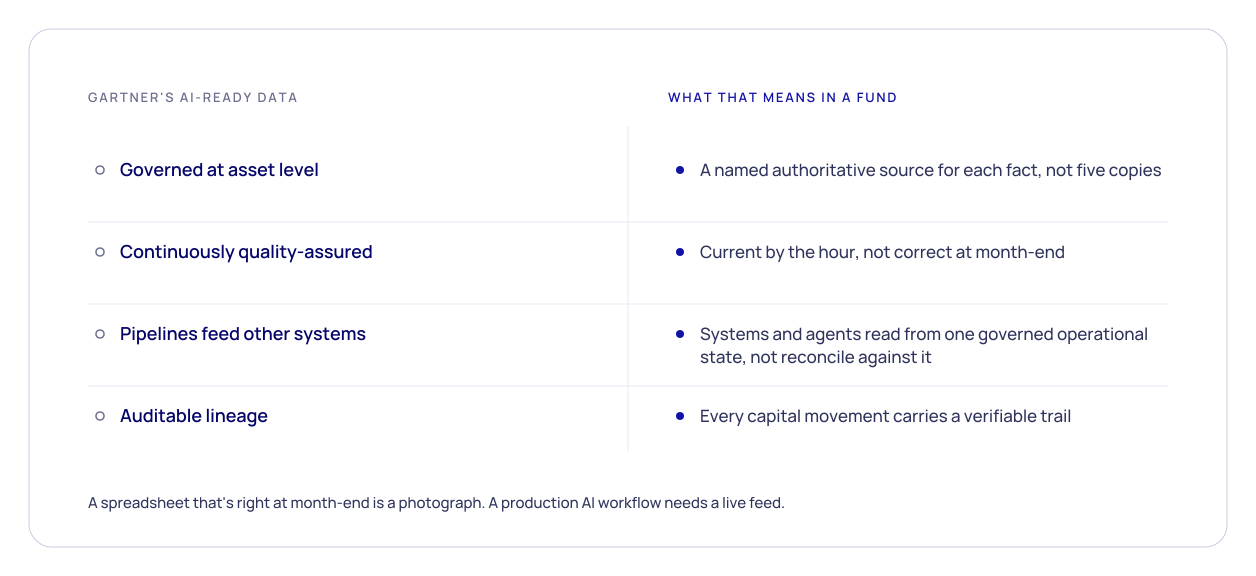
AI-ready data is aligned to the use case, governed at the level of the individual asset, fed by pipelines with quality checks built in, and quality-assured on a continuous basis.
The word that matters is continuous. A production AI workflow depends on trustworthy inputs, and it needs them current by the hour. Most fund operations validate their records on a reporting cadence: a month-end reconciliation, a quarterly close, an annual audit.
So here is the uncomfortable translation. A spreadsheet that is correct at month-end is not an AI-ready record. It is a photograph of the truth, taken once, going stale the moment it is saved.
Now translate the rest of the Gartner definition into fund terms, and the answer is subtler than "build one master database."
It describes a governed layer that knows which system is authoritative for each fact. The administrator for the register. The custodian for custody. The bank for cash. The legal document for rights and obligations.
The work is making those relationships explicit, current and machine-readable, so every downstream process and every agent reads from one governed operational state instead of reconciling five copies by hand. This is a governed layer over the systems of record, not a single database swallowing them, which is a different thing from master data management.
And that governed operational state has to carry a verifiable history of every change. A business that moves capital under fiduciary and regulatory obligation cannot let an opaque model touch a distribution without an auditable trail behind it.
For a regulated fund, AI-readiness and auditability come as a pair: a record fit for an AI workflow that moves money has to be built to survive an audit at the same time.
Knowing the Record is Not Permission to Act On It
Here is the layer most AI commentary skips.
An agent can read that an investor is entitled to a distribution and still have no business releasing the payment.
Whether it can act depends on authority, approval thresholds, segregation of duties, exception handling, and the trail it leaves behind. Those are not data questions. They are questions of permission and control.
This is where AI in a regulated fund parts company with AI in a general enterprise.
Understanding the record is the first requirement. Acting on it safely needs a second thing: a framework that governs what the agent is allowed to do, forces material exceptions to a human, and records every step as evidence.
A model with read access to a clean record and no controlled path to action is a research tool.
A model operating inside a governed action environment is infrastructure.
That environment is the harder thing to build. It is also the thing that decides whether AI advises your operation or runs part of it.
What Stays Human. What Doesn't
None of this points at the fund manager.
The investment decision is a judgment made under uncertainty, by people who carry the fiduciary weight of being wrong. The LP relationship runs on trust that no system holds on anyone's behalf. The read on a management team, the sense that a figure is accurate and still wrong, the conviction to size a position: that work sits above the friction layer and stays there.
Deloitte's own guidance on AI in private markets lands in the same place from the other side: adoption depends on unified data and human oversight to meet the accuracy and regulatory bar.
What does not survive is the reconciliation. The parallel books. The data chasing. The report assembled by hand from five sources. The audit week spent reconstructing a trail that should have recorded itself.
That is the operational friction in the title. And AI can remove it, on one condition: the layers beneath it have to be put in order first, so there is one governed operational state for the model to act on instead of five copies to guess between.
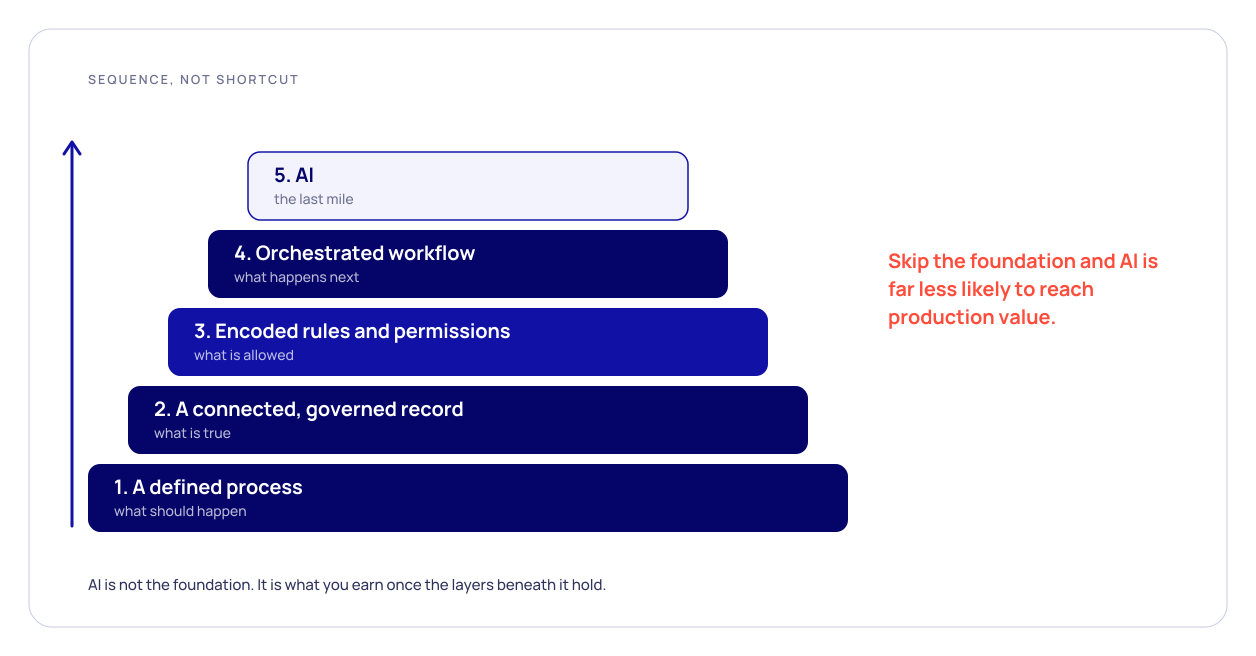
Sequence is the whole game, and it has more steps than the hype admits:
- Define the process, so there is a rule to follow rather than a habit to guess at.
- Connect and govern the record, so each fact has one authoritative source.
- Encode the rules and permissions, so the system knows what is allowed and what has to escalate.
- Orchestrate the workflow on top of that.
- Then apply AI.
Only at step five does AI become the last mile rather than a faster way to fail. And at that point, changing the model is the easiest part of the stack. The operational foundation beneath it is the part that is hard to copy, which is what makes it the advantage.
The firms most likely to capture the value McKinsey describes are the ones that complete steps one through four first. Those foundational steps are the operating model the value depends on. Skip them and AI is far less likely to reach production value.
A Question to Ask
The two loud conversations ask whether AI will take the job, or which jobs it will absorb.
For a COO, both are the wrong question.
The right one is quieter, and less comfortable: is your operation in a state where automation would help, or in a state where automation would just fail faster and at greater cost than the manual process it replaced?
That is not a question about ambition or budget. It comes down to a few things you already know the answer to. How many versions of your ownership record exist. How often they are reconciled. Whether the processes on top of them are defined well enough that a machine could act inside them without inventing the rules as it goes. And whether any of it could be trusted at nine on a Tuesday morning without a human checking the work.
AI will not replace the people who make your fund worth investing in.
For the funds that do the foundational work, it will clear the friction that has been holding those people back.
For the funds that skip it, it will remove nothing, at considerable cost. And the gap between those two groups is where the next decade of relative performance gets decided.