Most private markets businesses don't fall over on a bad quarter. They fall over on an ordinary Tuesday, when three investors need their entity structures re-mapped, a reporting cycle is running behind because a spreadsheet quietly stopped reconciling, and somebody on the ops team is re-keying KYC that was already completed for the same client on a different vehicle six months earlier. None of it looks urgent from the outside. It rarely makes it into a board pack. But it is the kind of friction that nobody actually chose, and it adds up in ways that are hard to see until the business has grown past the point where hard work alone can paper over it.

That's really the story of how most operating stacks in this industry come to exist. They aren't designed so much as accumulated, one urgent fix at a time. A registry gets built the week a spreadsheet finally breaks under its own weight. A reporting tool gets bolted on because an investor asked for something the old process couldn't produce in time. Onboarding runs through email because that was fine when there were twenty investors, and nobody thought to revisit it once there were two hundred. Each of those calls made sense in isolation, and most of them were made by capable people trying to solve a real problem quickly. What none of them were built for was what came next.
You can see this playing out at scale right now, on both sides of the region. Australian superannuation assets passed $4.4 trillion as of March this year, up almost 8% on the year before, and a growing share of that pool is finding its way into private markets rather than sitting in listed equities. Meanwhile Singapore just overhauled how single family offices are regulated. From the middle of June, a qualifying family office no longer needs a licence from MAS to operate. It simply notifies the regulator, banks with a licensed institution, and files an annual return showing what it holds and where. That's a genuinely lower barrier to setting one up. It's also, in practical terms, an invitation for a lot more capital to organise itself formally, faster than before, and with less friction between the decision to set up and the first cheque being written.
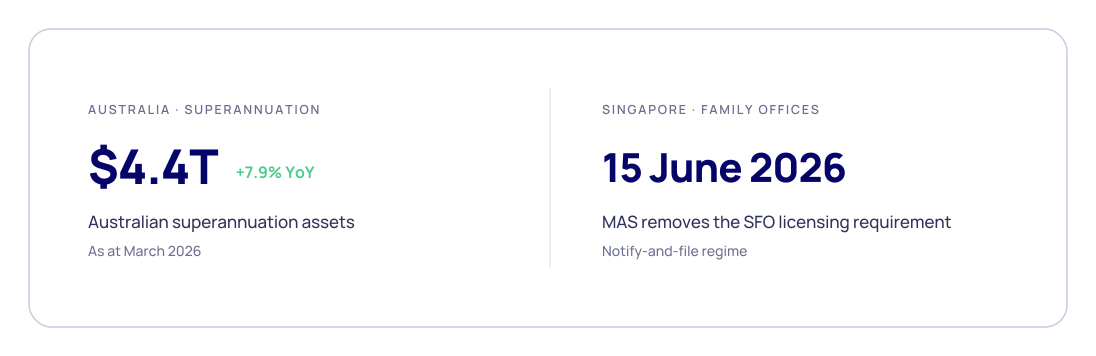
Put those two things together and the picture is fairly clear. More capital is moving into private structures, and it's arriving with less regulatory hand-holding along the way, not more. That doesn't mean the expectations get lower. If anything the opposite is true, because investors, allocators and now regulators are all asking sharper questions about how a manager actually runs day to day, not just what they invest in. A lighter licensing regime tends to shift more of the burden onto the manager to prove they can be trusted operationally, since there are fewer external checks doing that work for them by default.
This is where operational debt starts to bite. At a hundred investors, the friction I described earlier is annoying but manageable, a known cost absorbed by a good team working a little harder than they should have to. At a thousand investors, across several jurisdictions and a handful of products, the same friction doesn't just get bigger. It compounds. More investors mean more variation in onboarding. More products mean more exceptions in reporting. More jurisdictions mean more rules that somebody has to remember to apply by hand, correctly, every single time. None of that is a reflection on the team. It's a reflection of infrastructure that was never asked to carry that kind of weight, and mostly wasn't designed with the question in mind at all.
The firms handling this well tend not to be the ones with the cleverest investment thesis. They're the ones who took their operating environment as seriously as their strategy early on, long before it became a visible problem, and built or chose infrastructure that was meant to absorb growth rather than something that simply happened to survive it so far. That's a different way of thinking about operations. Not as the plumbing behind the business that nobody notices until it leaks, but as the system that actually determines how fast a firm can grow, how much trust it earns from the capital it's trying to attract, and how much time its people spend fighting friction instead of doing the work that matters.
Private markets have spent the last decade getting a lot more sophisticated about where capital goes. The next decade is likely to be shaped just as much by how well that capital is actually operated once it arrives.